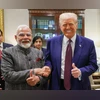
At around the same juncture in history when Donald Trump has armed Elon Musk with a flamethrower to gut his bureaucracy from inside, the Modi government has notified the 8th Pay Commission.
The first is a dramatic, if chaotic, campaign to minimise government and cut costs. The second is a significant expansion of the government and wage bills, timed with the 2029 elections. Both won power, more or less, on the same promise. We’d prefer Mr Modi’s words: Minimum government, maximum governance.
You need no better evidence of the dramatic divergence in the two leaders’ approach to governance and its costs. Mr Trump is the insurgent who sees career civil servants as evil. They are assured a full career of service, irrespective of who wins or loses elections. They govern, or help the government by following set rules and norms.
By definition, this calls for no political or ideological loyalty. In fact, that is absolutely abhorred in this system. In the Trumpian view, this is an obscenity. It’s the unchallenged reign of the unelected, and he will take no more of it. So, he’ll burn it down.
For Mr Modi, the career civil servant represents continuity, change and loyalty. There is no real problem with our administrative structure and personnel as long as they adapt with the politics of the day. This is the reason we’ve seen the greatest empowerment of the “selected” (by UPSC) bureaucracies in the Modi era. The constitution of the 8th Pay Commission is just a metaphor. Under Mr Modi, the central government has expanded at a breathtaking pace. For evidence, go for a “before and after” spin in the larger New Delhi region (not just the Lutyens Zone) and see how many new “Bhawans” have come up.
In Mr Trump’s America, his newly appointed Federal Bureau of Investigation (FBI) chief made a name for himself by promising to turn the FBI headquarters in Washington into a museum and either lay off most of its personnel or scatter them across the US, especially Alabama. It would be the Indian equivalent of sending the personnel of the Central Bureau of Investigation (CBI) to Kushinagar or Sonbhadra in UP, or maybe Medak in Telangana or Kurnool in Andhra Pradesh. But see the contrast in India.
The National Investigation Agency (NIA) has a stunning new and massive bhawan of its own in the CGO complex by the side of the Jawaharlal Nehru Stadium. The Delhi Police has a swanky new “home” in the heart of Lutyens while retaining its original one in the ITO area. The Enforcement Directorate (ED) had its own building. It’s way better than its original office, in Lok Kalyan Bhawan, next to Khan Market. Lok Kalyan Bhawan, to be fair, is a sarkari slum, no human beings deserve to work there. I am hoping it is earmarked for demolition in the rebuilding of Lutyens Delhi. The NCRB and BPR&D too got sprawling new headquarters in Mahipalpur, in 2017. The National Human Rights Commission is among those occupying one of the towers in the new red sandstone mini-city behind the INA market, abutting the Barapullah flyover. The National Green Tribunal is now a massive New Delhi bureaucracy with a bhawan of its own on Copernicus Marg and zonal centres sprouting across the country. Nobody would bother a performance audit on such privileged new bureaucracies. The state of the environment, and the impact of the NGTs, if any, you can see, feel, and smell for yourself. Similarly, at the Centre and in the states, all relatively new institutions (not necessarily founded under the Modi government) have seen a breathless expansion, and “bhawanisation”. Count the Central Information Commission (the states have their own), the Lokpal and Lokayuktas in states, and the many tribunals.
Turn your attention to the government being in business. Barring the sale of Air India, almost all Central Public Sector Undertakings (CPSEs ) have not only remained intact under the Modi government, but have also seen massive new investments with taxpayer money. This year’s Budget has earmarked ₹14.7 trillion for further investments in CPSEs. Attacked by Rahul Gandhi often for “selling out” the PSUs, Mr Modi has himself spoken multiple times underlining “how much better” they’ve done under him. The Centre just promised to invest another ₹11,440 crore into Vizag Steel Plant, which had been on the privatisation list for almost two decades.
Just how well have the CPSEs done? While the broader indices, Nifty and Sensex, have fallen about 13 per cent from their peak, the CPSE index has crashed — hold your breath and cry for your tax money — by about 30 per cent.
That amounts to a neat loss of about ₹13 trillion, or about $148 billion (nearly double of India's defence budget). Think about what India could do with that kind of money. Build a full north-south bullet train? Multiply several times the amounts paid in PM Kisan Samman? Or maybe buy two squadrons of those F-35s and also have Mr Trump smile. And you will still have about $120 billion left. Please do note that while the Congress has traditionally been statist, it’s the Bharatiya Janata Party leaders whose favourite line over the decades has been: Jis desh ka raja vyapari, us ki praja bhikhari (in a nation whose king is a businessman, the subjects become beggars). In India under Mr Modi, the problem is never that there is too much government—or that there could ever be too much government. It isn’t about the costs either. That the civil services are unelected is actually seen as a good thing. Ideological purity is ideal, but where it isn’t available, there are always tools to make civil servants fall in line—whether through rewards or punishments. The best postings, empowerment, and if you are really valued, a life of almost no retirement.
After initially appointing specialists into key positions — for example, at the Reserve Bank of India and the Securities and Exchange Board of India, we are back to the trusted IAS. The direct recruitment at joint secretary level is an idea that disappeared so fast that we never saw its time come. There is, however, a brave effort underway under economist Sanjeev Sanyal to at least abolish a whole bunch of new bodies set up as sarkari employment programmes. It’s a good initiative. Just note that in our system, nobody loses their jobs. They just get “reallocated” elsewhere. And you know what they’ve said forever in Punjabi: Jehde lahore bhaide, oh Peshawar vi bhaide (one who’s useless in Lahore, in also a disaster in Peshawar). The joke is on the exchequer.
In the Modi Cabinet, too, the key positions now, from external affairs to petroleum, railways, income tax, and more are with former civil servants. The Modi system’s comfort lies exactly where the Trumpian hate begins. We aren’t saying what’s better or worse, because who knows where Trump’s slash-and-burn will leave America. We are only making the point that the Trump and Modi approaches to building governance structures stand in stark contrast to each other.
For Modi/BJP supporters, Deep State is some amorphous entity, including global foundations, Left-activist corporations and investors, and also intelligence proliferations working in cahoots with them. The Trumpian conception of the Deep State, by contrast, is the house where unelected civil servants live, whose careers transcend multiple presidencies and who won’t bend to political will. He must burn it down. Ideally, he’d do this with his judges too.
Mr Trump and Mr Modi are two very different leaders, armed with contrasting political method and style. It’s fascinating how this reflects in their view of governance, and more importantly, to the entity called government. One is wrecking, while the other continues expanding it.
By special arrangement with ThePrint