When the first Rajdhani left Delhi for Howrah on March 1, 1969, at 5:30 pm, it collapsed a journey that took more than 24 hours to 17 hours. The ticket price was ₹280 for air-conditioned (AC) first class and ₹90 for AC chair car. The glistening red and white fully AC train, with quality meals thrown in, zipped past iconic stations in Uttar Pradesh and Bihar at 120 km per hour
without stopping. It is amusing to recall that many editorials then branded it “elitist” and a luxury that a poverty-stricken India could ill afford.
Well, the transformational agenda now is clearly high-speed rail (HSR); and once again, we should be careful not to confuse leapfrogging technology development with elitism. HSR is poised to get mainstreamed into India’s railway passenger network at a time when four parallel developments are underway.
One, the railways is itself going through an era of rejuvenation. The focused expansion of the rail network, dedicated freight corridors, imminent completion of the Bullet Train project, growing numbers and variety of Vande Bharat trains, Regional Rapid Transit Systems (a la Delhi-Meerut and others), station redevelopment, and modern ‘Kavach’ safety systems are all a testimony to the unfolding vision for this crucial national transporter. HSR should be an integral part of the rejuvenation.
Two, the Indian railways operates 13,000 passenger trains daily, ferrying 24 million passengers (just 2 million short of the population of Australia). Of this about 10 million are non-suburban, long-distance passengers, and about 0.5 million (5 per cent) travel in AC coaches. This is the well-heeled segment that is increasingly threatened by affordable air travel, and inter-city luxury coaches.
Three, India’s economic indicators suggest the country is primed for a transformative leap in rail technology. India’s per capita gross domestic product (on a purchasing power parity basis) is at par with the gross domestic product of other countries at a time when they pioneered HSR several decades ago — pointing to the fact that this is the right time for India to make the leap from conventional to HSR.
Four, an HSR training institute is being developed in Vadodara and it will have high-end facilities to train about 4,000 people on an ongoing basis. Capacity-building for HSR is underway.
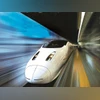
With all these, HSR is in many ways an inevitable option because the Indian Railways’ network is so large and complex that upgrading the existing setup to meet contemporary travel demands may take decades. According to the International Union of Railways, the upgrade of existing lines to a maximum speed of 200-220 km per hour qualifies as HSR, as much as a new alignment designed for speeds of 250 km per hour or more. This definition offers India a flexible approach to modernising with an HSR thrust. It is interesting to note that the Ahmedabad-Mumbai bullet train is expected to have a top speed of 320 km per hour — the same as Japan’s Shinkasen. In China, the Shanghai Maglev reaches a top speed of 431 km per hour.
The beneficial fallouts of HSR are many.
Shifting AC I and AC II passengers to HSR will free up capacity for sleeper and second-class travel. It will ease continuing congestion on the high-density networks of the Indian Railways with its separate lines. It will accelerate dispersing urban agglomerations — often popularly referred to as “sleeper towns” — and play a potent role in decongesting major cities. Every kilometre of HSR provides five times the capacity of conventional rail and can play a crucial role in developing Tier-II and -III cities.
It is well recognised among railway specialists that HSR is a complex system requiring seamless integration of various technologies, including rolling stock, track design, signalling, centralised control, safety, and operating and maintenance systems. While India has demonstrated its ability to develop trainsets domestically, many other subsystems still need to be imported. The induction of domestic HSR technology as an overarching ecosystem with an “Atmanirbhar” mindset must be a significant factor in the journey. A new tech-oriented institution is being suggested which could be called the National HSR Technology Corporation.
Plans are afoot to develop several HSR corridors with the National High-Speed Rail Corporation, examining seven (or more) detailed project reports. There is a plan for indigenously manufacturing “bullet trains”, with the Integral Coach Factory in Chennai developing faster Vande Bharat prototypes. The Indian Railways has awarded BEML a contract worth ₹867 crore for two high-speed trainsets with a design speed of 280 km per hour.
The selection of HSR corridors needs to be based on an evolved understanding of development economics, with an assessment of ridership, paying capacity, regional representation, contiguity, distance and capex.
The Infravision Foundation has investigated these aspects rigorously and found that the following corridors emerge as priorities for development by 2035:
Corridor 1: Delhi-Rewari-Jaipur-Ajmer-Jodhpur-Ahmedabad-Mumbai;
Corridor 2: Chennai-Mumbai via Tirupati, Bengaluru, Tumkuru, Davangere, Dharwad, Belagavi, Kolhapur, Satara, Pune, Navi Mumbai, with a spur to Goa;
Corridor 3: Delhi-Sonipat-Panipat-Karnal-Ambala-Chandigarh-Ludhiana-Jalandhar-Amritsar; and
Corridor 4: Delhi-Agra-Lucknow-Varanasi-Patna-Kolkata.
The success of countries such as Japan, Italy, and Spain — each charting its unique course in HSR development — shows that there is no one-size-fits-all solution. India must forge its own path.
Let us move fast on HSR.
The author is an infrastructure expert. He is also founder and managing trustee of The Infravision Foundation. Expert railway research inputs from Ramakrishnan T S