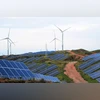
Local manufacturing is being pushed through a combination of incentives for manufacturing and disincentives for imports. If the import price is low enough even after tariffs, neither lever works. The price equilibrium of a protected market also settles at a level higher than it would without protection — as is the case in the US.
Europe has also been nudging local panel manufacturing. Swiss solar panel maker Meyer Burger cited deteriorating business climate in Europe as a reason to shift its focus to setting up manufacturing plants in the US, after announcing the closure of a manufacturing unit in Germany. “The module production at our Freiberg (Saxony) site in Germany was discontinued in mid-March 2024, which shall lead to significant cost savings from April. The solar cell production in Thalheim, Germany, will continue to support production ramp-up of US solar module manufacturing in Goodyear, Arizona, for the time being,” it wrote in a statement last month.
India’s decision to re-impose curbs on solar panel imports — after a series of policy turns in an attempt to promote made-in-India panels while also keeping solar power generation ultra-competitive — is positive for manufacturers but would mean higher prices for developers at a time when the global supply glut is pointing toward ever-lower prices.
The world’s largest manufacturers are vertically integrated and have gargantuan capacities. China’s JinkoSolar, for instance, shipped over 78 gigawatts in 2023. It expects this to increase to 100-110 gigawatts this year. That is more than the combined new-build forecast for the four largest markets after China — the US, India, Brazil and Germany. China could install more than 300 gigawatts this year.
The European Commission started a probe into a solar contract in Romania this week under its Foreign Subsidies Regulation — aimed at investigating the potentially market distortive role of foreign subsidies given to a bidder in a public procurement procedure.
“Solar panels have become strategically important for Europe: For our clean energy production, jobs in Europe, and security of supply,” Thierry Breton, the EU’s internal market commissioner, was quoted as saying by Bloomberg News. The investigations “aim to preserve Europe’s economic security and competitiveness,” he added.
Methane control
The writer is a New York-based senior editor, global policy, for BloombergNEF; vgombar@bloomberg.net
One subscription. Two world-class reads.
Already subscribed? Log in
Subscribe to read the full story →
Smart Quarterly
₹900
3 Months
₹300/Month
Smart Essential
₹2,700
1 Year
₹225/Month
Super Saver
₹3,900
2 Years
₹162/Month
Renews automatically, cancel anytime
Here’s what’s included in our digital subscription plans
Exclusive premium stories online
Over 30 premium stories daily, handpicked by our editors


Complimentary Access to The New York Times
News, Games, Cooking, Audio, Wirecutter & The Athletic
Business Standard Epaper
Digital replica of our daily newspaper — with options to read, save, and share


Curated Newsletters
Insights on markets, finance, politics, tech, and more delivered to your inbox
Market Analysis & Investment Insights
In-depth market analysis & insights with access to The Smart Investor


Archives
Repository of articles and publications dating back to 1997
Ad-free Reading
Uninterrupted reading experience with no advertisements


Seamless Access Across All Devices
Access Business Standard across devices — mobile, tablet, or PC, via web or app
)