The regulator spoke about forbearance. The industry spoke about a supportive government. And the business delivered a stellar performance.
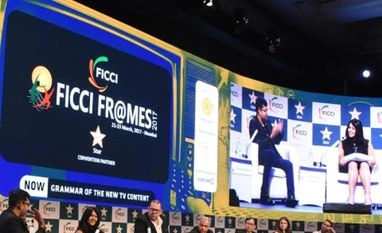
The first full-fledged Ficci-Frames, after the three-year pandemic hiatus, began on a great note. Ficci, the Federation of Indian Chambers of Commerce and Industry, hosted the three-day event, the biggest in the Indian media and entertainment business calendar, earlier this month in Mumbai.
P D Vaghela, chairman of the Telecom Regulatory Authority of India (Trai), the body that regulates the largest chunk of the now Rs 2.09-trillion Indian media and entertainment business, was categorical that the regulator should not be responsible for fixing tariffs. But the conflict between broadcasters, multi-system operators and last-mile cable operators made tariff regulation inevitable. He spoke about the need to protect the 81,000 local cable operators.
This is, arguably, the first time in some years that Trai is re-thinking its role in tariff setting— something it has held in a vice-like grip since 2004. It doesn’t need to. If you want to watch television, you have a choice of three pipes that bring the signals or content to your house — cable, DTH and fibre/wireless bandwidth from a telecom operator. It is a highly competitive business with lots of options. And it is not an essential commodity. Why then should the regulator be fixing tariffs, discounts or packages? For long this publication has recommended that Trai move away from price regulation.
Mr Vaghela has invited suggestions from the industry on a new broadcasting paper. If this is a first step towards lowering Trai’s control over pricing, it couldn’t have come at a better time. The New Tariff Order, or NTO, series, the growth of streaming, and the pandemic have devastated the television business.
For the first time since the growth of private television in the early 1990s, broadcasting revenues have declined. From Rs 72,000 crore in 2021, they were down to Rs 70,900 crore in 2022, going by the Ficci-Frames 2023 report put together by EY.
At the top-end, consumers are shifting to subscription-driven streaming video. That is limited to 2-3 million homes, reckon analysts. The real devastation is happening at the middle and lower end, where many are going to YouTube and DD Freedish.
The state-controlled free DTH operator is, going by Media Partners Asia data, the largest TV platform in India and among the five largest in the world. At 58 million homes, it is over one-fourth of all TV homes reached and a third (278 million) of the people who watched TV in 2021. DD Freedish is not addressable and most of the strictures that apply to private broadcasters and DTH operators do not apply to DD Freedish. The 70-odd channels that operate on it received approximately Rs 3,000 crore in advertising last year. This makes it a somewhat uneven playing field and several speakers at the conference acknowledged as much.
YouTube, which is primarily free, had 455 million unique users in March 2023, says Comscore data. According to research that YouTube India Managing Director Ishan John Chatterjee presented, it contributed Rs 10,000 crore to the Indian gross domestic product and created 750,000 full-time jobs.
Not surprisingly, both brands feature prominently in the EY Report. The report is largely good news. It shows that the business is finally recovering after the slump that the pandemic brought on. After crashing from Rs 1.9 trillion in 2019 to 1.5 trillion in 2020, the Indian media and entertainment business crossed Rs 2.09 trillion in 2022. It is on track to grow at a compound annual growth rate of 10.5 per cent, says the report. More importantly, film, the business that powers much of OTT, TV and music, is back on track.
For me, the talk of the event came from Gopal Vittal, managing director and CEO, Bharti Airtel. He reckons that to harness the power of 5G, the rest of the ecosystem needs to deliver. “You can’t make out the difference that 5G offers with just MS (Microsoft office) or browsing,” he said. Among the challenges he listed was the changes needed in the distribution ecosystem for content.
While research agencies put the total number of OTT subscribers at over 100 million, Mr Vittal believes that only around 20 million people subscribe directly to an OTT platform, with the rest being part of telecom bundles. Many of the 40 OTTs in India will perish unless the business model issues around aggregation, distribution and content are dealt with. Investors have been saying this for some time now. Just like DTH operators helped make sense of the over 800 channels on offer by packaging and marketing them to subscribers, there is the need for aggregation in OTT too.
From its focus on visual effects, animation and digital to the challenges and developments in TV, the event covered everything that Indian media and entertainment is grappling with or celebrating currently. Now down to business.
http://twitter.com/vanitakohlik