We have normalised congestion in our lives. We stand, sit, wait, fume, curse, groan, and get angry and frustrated. By the time we get to our destination, we are so exhausted that it feels as though the day is over before it has even begun. Each day, our journey ends in helplessness. In this daily grind, what we often fail to count for are the hours of our lives we lose — time away from family, friends, or even leisure. We discuss it endlessly — being stuck in traffic has taken over our conversations; yet, what is surprising is that we do not really understand why this is happening or what needs to be done. The only solutions in our mind are going signal-free, building flyovers, and widening roads. But the jam stays, and even gets worse.
My colleagues at the Centre for Science and Environment and Down To Earth have deconstructed congestion in 50 cities and towns across the country. They asked a simple question: How does India move? The answer, unsurprisingly, is that it often does not. City after city, people told us of their daily struggle to commute. Whether small or large, metro or hill town, the difference between peak and non-peak travel times is double or more in most cities; in other words, it takes twice as long to reach your destination during rush hours. In some cities, like Delhi and Bengaluru, the peak period is getting extended — so much so that roads are now gridlocked beyond office hours. We also know that the more the congestion, the more the air pollution, with vehicles idling on roads emitting toxic fumes. So, congestion is not only taking away our time: It is also adding to the stress and health burden from air contaminants that reduce our life spans. It is bad. And it must not be normalised.
To beat the trauma of congestion, we need to understand its political economy. People are increasingly shifting to private transport — two-wheelers or cars — for their daily commute. This means that even as cities add road infrastructure and flyovers, cars, the most inefficient users of road space, fill them up. Delhi, for instance, registers over 500 new cars every day. This is despite all the congestion and the fact that cars account for only 7-11 per cent of daily trips in the cities we surveyed. In Bengaluru, another city notorious for congestion, only 7 per cent of total trips are with cars, according to the data from the city’s comprehensive mobility plan. The question, then, is this: Where and how will we make space for the remaining 80-90 per cent of trips, if they are made using cars?
What dominates the commute in cities are two-wheelers — 30 to even 40 per cent of daily trips are by this mode. But what is worrying is that two-wheelers are losing ground to cars in smaller cities. This is probably because, unlike in metros, where people prefer two-wheelers due to congestion (they can move faster), there appears to be more space in sub-million cities, and so cars fill the roads. Congestion then rears its ugly head. This leapfrog augurs bad news.
The fatal flaw is the lack of public transport modes in cities. Not only are public buses few and far between, but what cripples this system is its unreliability — ironically, the result of congestion itself. As buses get stuck in traffic, they get delayed, and people shift away from them. In cities with highly efficient metro systems, there is some relief for commuters. But here, the question of convenience and affordability arises, as people count not just the cost of the metro ticket but also the fares for rickshaws, taxis or other last-mile options they take to get to the station and eventual destination. This is also because our roads are not designed for pedestrians and so, the walk to the station is just not safe or possible.
Amid all this, what is growing exponentially and adding to the mayhem on our roads is the informal para-transit systems — from conventional auto-rickshaws to the assembled battery rickshaws and mini-buses. This mode is crucial, since it provides last-mile connectivity and serves as a preferred and affordable travel option for millions in cities. However, because it is largely unplanned and unregulated, it adds to congestion. But the fact is we cannot fix transport in our cities unless we recognise these informal systems and integrate them into our planning and regulatory frameworks.
What, then, is the way out of this jam? We know what needs to be done — it is a no-brainer. More mass transport systems, from buses to metros to trams, that can move people efficiently. More walkable sidewalks so that last-mile connections can be made safely. More integrated para-transit systems so that there is regulation on the movement of these vehicles. Stricter penalties for violating traffic rules, especially for illegal and unmanaged parking, which happens just about anywhere. We know all this. But we are still not getting our act together; instead, we just keep hoping that the next road widening will make the nightmare go away. Let’s wake up. Let’s smell the traffic.

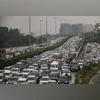 "The solution to urban congestion is mass transit systems, not more roads")












 Connect with us on WhatsApp