With a red carpet, a 21-gun salute, a guard of honour, and the nation’s highest award for the Indian Prime Minister, the Maldives and India signalled a critical reset of relations, which had touched the nadir in 2023. Then, newly elected Maldivian President Mohamed Muizzu demanded the withdrawal of 90 Indian military persons, stationed there for medical evacuation and maritime surveillance, on the grounds that the decades-long presence infringed on Maldivian sovereignty. An agreement with China for “non-lethal” weapons supply followed a month later. But the tensions between New Delhi and Male date back 11 years, when the Maldivian government cancelled an airport-construction project by Bengaluru-based GMR group, then its biggest foreign investment project at $511 million, allegedly at Beijing’s behest. Since then, the island-nation enthusiastically signed on to China’s Belt and Road Initiative (BRI) with projects for an airport upgrade, a major bridge and low-cost housing. Aware of the growing China factor in this island chain, strategically placed along major Indian Ocean shipping lanes, India chose patient, constructive diplomacy over confrontation to rebuild relations.
Even as Mr Muizzu signalled closer ties with China, choosing Beijing first for an overseas visit in January last year and signing a flurry of agreements, India retained ties with Male. Early last year, India replaced military persons with technical staff from state-owned Hindustan Aeronautics. India also continued to fund critical infrastructure, including major inter-island connectivity projects. New Delhi extended support by rolling over a $50 million Treasury bill, plus a $400 million emergency financial package and $360 million currency-swap agreement to help the Maldivian economy, which was reeling from a debt crisis. Much of this debt is the legacy of Chinese loans incurred for ill-planned and expensive BRI projects, with its debt rising to over 120 per cent of its gross domestic product. For instance, recovering the steep cost of a signature “friendship bridge” linking the airport island to the main island required such high tolls that locals preferred cheaper alternative routes. With delays in land acquisition and construction schedules, the Maldives’ low-cost housing project eventually proved too high-cost for locals to afford.
The problem of poor project planning and execution has been compounded by the slowdown in the island-nation’s tourism revenues, which are still to recover from the pandemic shock. Matters were made worse by gratuitously insulting remarks about India and its Prime Minister by three Maldivian ministers, which precipitated a boycott of the Maldives by the Indian tourism industry. For years, Indian nationals were the largest cohort visiting the Maldives. Recognising this, the Maldivian government suspended the offending ministers. But with Indian tourist arrivals dropping more than 30 per cent in calendar 2024, the sharp drop in tourist dollars prompted the Maldivian government to appeal to Indian tourists to return, including hosting high-profile networking events. But the numbers are yet to ramp up to pre-2024 levels.

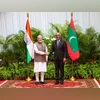 "Back in the sun: Patient and constructive diplomacy pays off in Maldives")












