Home / Opinion / Editorial / Prioritise safety: Weaknesses in railways must be addressed quickly
Prioritise safety: Weaknesses in railways must be addressed quickly
The Bilaspur collision is a stark reminder that India's railway expansion must be matched by a stronger, technology-driven safety culture focused on prevention, not reaction
premium
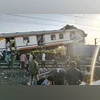
People gather after a passenger train collided with a goods train near Bilaspur railway station, Chhattisgarh, on Tuesday, November 4. (Photo: PTI)
3 min read Last Updated : Nov 06 2025 | 10:58 PM IST
A collision between a local mainline electric multiple unit (Memu) passenger train and a goods train near Bilaspur, Chhattisgarh, has once again put the spotlight on India’s railway-safety preparedness. Initial investigation suggests that the accident occurred after the passenger train passed a signal set at danger — a reminder that human error and signalling lapses remain persistent weak points in India’s vast network. The tragedy comes even as the Union Cabinet recently cleared ₹24,634 crore worth of multitracking projects across four states, adding nearly 900 km of lines. Expansion, however, cannot be a substitute for safety. While “consequential” train accidents declined from 55 in 2019-20 to 31 in 2024-25, each such mishap underscores that progress on safety is uneven. The government has allocated about ₹1.16 trillion for safety-related expenditure in 2025-26, with track renewals accounting for around one-fifth of this amount, according to the FY26 Budget estimates. Safety expenditure as a percentage of railway expenditure has declined from 27 per cent in FY19 to 21 per cent in FY26.
Modernisation measures, such as installing the indigenous anti-collision system, Kavach, and the expansion of track-circuiting and electronic interlocking, are steps in the right direction. Yet, implementation remains patchy. The Economic Survey 2024-25 noted that of the 62 pending stations identified for electronic interlocking, only 25 were completed in FY25, leaving 37 yet to be upgraded. Managing both heavy freight and dense passenger traffic makes the challenge even tougher, while fatigue among the staff adds to safety risks. Nevertheless, the Indian Railways has made encouraging technological strides. The recent collaboration of the railways with Dedicated Freight Corridor Corporation of India Ltd (DFCCIL) aims to use artificial intelligence- and machine learning-based inspection of rolling stock and tracks. CCTV cameras are being installed at all level crossings to prevent collision and trespassing. However, these scattered efforts need to be brought together under a single, well-coordinated safety strategy that connects technology, infrastructure, and human factors.
Safety demands a multipronged strategy. First, broaden the deployment of digital signalling, and fully roll out anti-collision systems like Kavach on all high-density and high-risk routes. Second, adopting predictive maintenance through sensors and artificial intelligence-based surveillance can help detect and fix vulnerabilities before they cause accidents. Third, crew management must receive focused attention: Better working conditions, fatigue monitoring, recruiting additional loco pilots, and specialised training on new technologies can drastically reduce human error. Fourth, independent safety audits should be mandatory for every expansion or modernisation project, ensuring that signalling, braking, and emergency systems keep pace with capacity growth. India undoubtedly needs more tracks, faster trains, and broader connectivity. But speed without safety is no achievement. The goal must evolve from “faster” to “safer and faster” for every new kilometre of railway line laid. For India’s 24 million daily passengers, trust in the railway system rests not just on efficiency or expansion, but on the assurance that the journey ahead is safe.




