Western approaches: PM Modi's three-nation tour has created useful momentum

The Comprehensive Economic Partnership Agreement (Cepa) is the second FTA signed between India and a West Asian nation - the first being with the United Arab Emirates (UAE) in 2022

PM Narendra Modi with Jafar Hassan, Prime Minister of the Hashemite Kingdom of Jordan (Image: X/@narendramodi)
Business Standard Editorial Comment
3 min read Last Updated : Dec 21 2025 | 9:56 PM IST
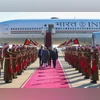
Prime Minister Narendra Modi’s tour to Jordan, Ethiopia, and Oman represented small but significant steps to reinforce India’s historically cordial trade and security relations with West Asia and Africa at a time of grave America-led geopolitical uncertainty both in the region and in global trade. The import of these visits lies as much in its external messaging — underlined by the unexpected gestures of the Ethiopian Prime Minister and Jordanian crown prince in personally chauffeuring Mr Modi — as the deals that were concluded. Of these, the free-trade agreement (FTA) signed between Oman and India, celebrating 70 years of diplomatic ties, marked an important step forward. 
The Comprehensive Economic Partnership Agreement (Cepa) is the second FTA signed between India and a West Asian nation — the first being with the United Arab Emirates (UAE) in 2022. This one, however, goes beyond the UAE FTA by allowing India near universal duty-free access to the Omani market (98.08 per cent of tariff lines), with immediate tariff elimination for 97.96 per cent. India, meanwhile, has reciprocated by liberalising nearly 95 per cent of India’s imports from Oman by value. Though Oman is by no means one of India’s largest trade partners in the region — at $10 billion, it looks small before the $100 billion with the UAE and the $42 billion with Saudi Arabia — it signals major potential for economic engagement and expansion. A provision for 100 per cent foreign direct investment (FDI) by Indian companies in major services sectors offers opportunities for building on India’s traditional strengths in services in West Asia and Africa as does a liberalised mobility framework for Indian professionals. The fact that Muscat has agreed to lift its ban on the export of rough marble blocks to India, enabling the country to gradually replace its dependence on Turkiye, must also be seen as a key geostrategic gain. India’s relations with Turkiye have soured following Ankara’s support to Pakistan and its criticism of the Indian policy on Jammu & Kashmir. 
In Jordan, which marked the first leg of the trip and the Prime Minister’s first full bilateral visit, a raft of cooperation agreements cemented a long-standing friendship rooted in mutual economic interests. India is Jordan’s third-largest trade partner, and has long played an important role as a fertiliser supplier to India. In Ethiopia, mutually reinforcing bilateralism sought to enhance investment opportunities in this strategic country on the horn of Africa. Some 675 Indian companies are registered in Ethiopia and have invested $6.5 billion, mainly in textiles and pharmaceuticals. But as with the rest of Africa, India is a minnow compared to China. Though India is the third-largest source of FDI in Ethiopia, China and Turkiye have far more extensive trade, security, and military agreements with Addis Ababa, highlighting India’s need to deepen the scope and tenor of its cooperation. Doing so is becoming critical to Mr Modi’s ambitions for India to gain leadership of the Global South. India had played a role in Ethiopia’s membership of the BRICS grouping in January last year. Addis Ababa is also headquarters to the African Union (AU), with which discussions are on for an early scheduling of the India-Africa Forum summit, which has been in limbo for a decade. In both style and substance the three-nation tour marks a constructive continuum of India’s traditional ties with the region. The real test is how far New Delhi can capitalise on this momentum.

One subscription. Two world-class reads.

Already subscribed? Log in

Subscribe to read the full story →
*Subscribe to Business Standard digital and get complimentary access to The New York Times

Smart Quarterly

₹900

3 Months

₹300/Month

SAVE 25%

Smart Essential

₹2,700

1 Year

₹225/Month

SAVE 46%
*Complimentary New York Times access for the 2nd year will be given after 12 months

Super Saver

₹3,900

2 Years

₹162/Month

Subscribe

Renews automatically, cancel anytime

Here’s what’s included in our digital subscription plans

Exclusive premium stories online

  • Over 30 premium stories daily, handpicked by our editors

Complimentary Access to The New York Times

  • News, Games, Cooking, Audio, Wirecutter & The Athletic

Business Standard Epaper

  • Digital replica of our daily newspaper — with options to read, save, and share

Curated Newsletters

  • Insights on markets, finance, politics, tech, and more delivered to your inbox

Market Analysis & Investment Insights

  • In-depth market analysis & insights with access to The Smart Investor

Archives

  • Repository of articles and publications dating back to 1997

Ad-free Reading

  • Uninterrupted reading experience with no advertisements

Seamless Access Across All Devices

  • Access Business Standard across devices — mobile, tablet, or PC, via web or app

Topics :Narendra ModiBS OpinionBusiness Standard Editorial CommentEditorial CommentFTAJordanWest Asia

Next Story




