Home / Opinion / Specials / Best of BS Opinion: GST 2.0 reforms miss underlying core principles
Best of BS Opinion: GST 2.0 reforms miss underlying core principles
Today's pieces look at the available space for more rate cuts, the sorry state of tribunals, why GST reforms are not really that, and how India can harness its vast non-export MSME sector
Hello, and welcome to Best of BS Opinion, our daily wrap of the opinion page.
Although it is still early days, recent policy measures such as the GST reforms and income tax relief are likely to have pushed consumer demand in the economy. The extent to which this influences the monetary policy committee (MPC) - which sets the key policy rate - gross domestic product (GDP) growth projection for the current fiscal will be interesting to watch, says our first editorial, since it will need to balance the increased demand with the potential impact of the US tariffs. While growth is unlikely to be a concern, inflation could edge upward, cramping the space for more rate cuts. Also, transmission of the earlier rate cuts hasn't been very smooth, with yields on the 10-year government bond going up by about 25 basis points. It would behoove the MPC to wait and watch how growth, inflation, and fiscal positions pan out before taking a call on rate cuts.
Our second editorial notes with some concern that India’s commercial tribunals - which were set up to provide quick, cost-effective, and decentralised resolution to legal disputes - suffer from the same infirmities as the regular judicial system. According to a recent report, they have a backlog of 356,000 cases worth Rs 24.2 trillion as of September, with the estimated value of these cases equal to almost 7.5 per cent of gross domestic product. Of particular concern are the National Company Law Tribunal (NCLT) and the National Company Law Appellate Tribunal (NCLAT) - dealing primarily with the Insolvency and Bankruptcy Code (IBC) - which take an average of 752 days to settle cases against a statutory time limit of 330 days. The core reasons for various tribunals' performance mimic the judiciary's: legislative interventions, rising vacancies, procedural gaps, and concerns about independence. Unless meaningful reforms are instituted, and soon, tribunals will continue to reflect the weaknesses of India’s judicial system.
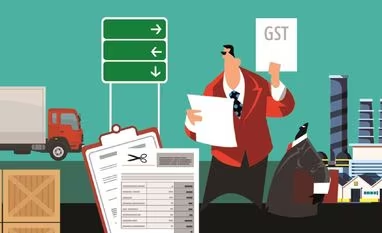
Indirect taxation, when designed poorly, can become an enemy of economic growth, write Vijay Kelkar, Arbind Modi and Ajay Shah. The GST, which was envisaged as a way to clean this up, fails to do so by only mimicking what it is actually meant to do since it lacks the underlying function, and is failed by legal and procedural blockages. Instead of a functional, seamless input tax credit (ITC), which maps the value added at each stage, it has become a tax on production no different from the earlier excise and service tax. When ITC is blocked, they write, the economic logic of GST itself is undermined, and tends to inflict systemic damage across the economy and its most dynamic sectors, particularly services. The recently unveiled Goods and Services Tax (GST) 2.0 reforms should have fixed this anomaly; instead, within the logic of the flawed system, they have made things worse. All of this can be fixed by establishing seamless ITC across all inputs, rationalising lower rates into a higher revenue-neutral slab, and automating the refunds process.
The recent 50 per cent tariffs imposed on India by the United States have had a chilling effect on export-oriented micro, small and medium enterprises (MSMEs), particularly those in gems-and-jewellery and apparel. However, as Tulsi Jayakumar points out, MSMES that generate nearly half of India’s exports are less than one-quarter of 1 per cent of the MSME base. This untapped segment could become the engine of future export-led growth. As the global economy diversifies supply chains, India has an extraordinary opportunity to transform its massive MSME sector. To grab it, policy must ease constraints on access to finance, simplify compliances, create multi-nodal logistics parks, and rapidly scale up its skilling mission. Else, we could see more nimble competitors overtake us quickly.
The Vietnam war will forever remain a scar on Pax Americana for its disastrous campaign that brought untold misery to the South East Asian nation, while striking a body blow to the vaunted United States' military machine. Overseeing it was one of American's most redoubtable bureaucrats - Robert McNamara. Philip and William Taubman's biography 'McNamara at War' captures the numbers-driven then defence secretary's overriding need for control during the war, writes James Santel. A much-later confession that he was wrong, they write, was likely motivated by his mania for authority as everything that had come before it. Without absolving McNamara, the Taubmans suggest that his admission of error is worthy of admiration, unlike many others since who have prosecuted at least two wars with nary a suggestion of mistakes or guilt.

 "Best of BS Opinion: GST 2.0 reforms miss underlying core principles")


 Connect with us on WhatsApp