Caste survey: A political pawn in a player's game ahead of Assembly polls

Is Nitish's masterstroke a strategic checkmate against BJP's Hindutva-welfarism mix? ARCHIS MOHAN writes
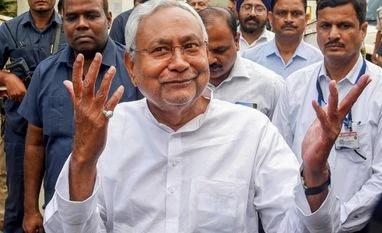
Nitish Kumar
Nitish Kumar (Photo: PTI)
Archis Mohan
7 min read Last Updated : Oct 08 2023 | 10:39 PM IST
In contrast to the Congress, which has dived headlong into calling for a nationwide caste census, making the demand to breach the 50 per cent ceiling on caste-based reservations its vital plank for the forthcoming Assembly elections, the Narendra Modi government’s strategy to blunt the Opposition’s broadside will involve fine-tuning the delivery of its welfare schemes to the beneficiary class, ‘Labharthi Varg’, that it has shaped over the past nine years, increasing allocations in some and emphasising that poverty has no caste.

The Bihar government’s caste survey, released last Monday on Gandhi Jayanti, could pull asunder the Bharatiya Janata Party’s (BJP’s) successful amalgamation of Kamandal-Mandal politics since the 1990s.

The BJP is wary that full-throated backing for Mandal 2.0 could upset its core upper-caste support base in the Hindi heartland. However, it cannot afford to dismay substantial sections of its voters among the non-dominant castes of the Other Backward Class (OBC).

According to Badri Narayan, director of Prayagraj-based Govind Ballabh Pant Social Science Institute, “government schemes have shaped a significant ‘beneficiary class’ among socially and economically weaker groups, instilling hope and aspiration in them and helping them lift themselves out of poverty”, which has helped the BJP smooth the edges of Mandalised politics in the heartland.

The National Book Trust recently published a book that Narayan and a team of academics have authored, titled Policies for the Poor and Marginals: A Study of Garib Kalyan Schemes in India, which details poverty alleviation, social inclusion, and economic empowerment measures of the government.

For example, of the total Pradhan Mantri Awas Yojana — Gramin houses constructed from 2016–23, 18.32 per cent were allotted to Scheduled Castes (SCs), 20.63 per cent to Scheduled Tribes (STs), 11.63 per cent to minorities, and a sizeable number to OBCs, making up 51 per cent of Pradhan Mantri MUDRA Yojana beneficiaries being SCs, STs, and OBCs, with OBCs accounting for 26 per cent.

According to a Centre for the Study of Developing Societies (CSDS) study, the BJP’s OBC vote share doubled from 22 per cent in 2009 to 44 per cent in 2019.

On Saturday, Prime Minister Narendra Modi chaired a meeting of top officials, including Principal Secretary Pramod Kumar Mishra and Cabinet Secretary Rajiv Gauba, to review the implementation of his Independence Day announcements, such as the Vishwakarma scheme, primarily targeted at landless OBCs who work with their hands, and to provide affordable credit to the poor and middle class for homeownership.

However, the Bihar caste survey’s findings pose a different challenge.

It has put the OBC population in the state at 63.1 per cent (36.1 per cent Extremely Backward Class, or EBC, and 27 per cent of OBCs), which is 11 per cent more than the 52 per cent countrywide OBC population estimated by the Mandal Commission in 1980.

As Sanjay Kumar, professor and co-director of Lokniti, a research programme at CSDS, points out, this will bolster the demand that OBCs, cumulatively, deserve reservations proportional to their population and not just the 27 per cent they currently receive.

The STs, with 7.5 per cent, and SCs, with 15 per cent, received reservations proportional to their population when introduced.

The Bihar survey puts the state’s SC population at 19.65 per cent, meriting an increase in their quota as well.

Thus, Opposition leaders have taken to echoing Ram Manohar Lohia’s ‘Pichhada paavai sau mein saath’ (backward castes deserve to get 60 per cent of resources) and Kanshi Ram’s ‘Jiski jitni sankhya bhaari, uski utni hissedari’ (share as per one’s strength), or as Congress leader Rahul Gandhi rephrased it, ‘Jitni aabadi, utna haq’ (rights proportionate to population).

The slogans are likely to become more strident in the days and months to come as the Opposition plans to mark Kanshi Ram’s death anniversary on October 9 and the year-long birth centenary celebrations of Bihar’s first OBC chief minister (CM), Karpoori Thakur, who was born in 1924 and pioneered reservations for OBCs and the economically poor in that state.

Opposition leaders believe that the BJP’s ‘poverty has no caste’ stance would not withstand its demand to secure justice, especially for EBCs, when the Bihar government releases the survey’s socio-economic data in the winter session of the legislative Assembly.

“Only a handful of states, such as Bihar, Karnataka, Maharashtra, Tamil Nadu, and Kerala, have been courageous in distinguishing between OBCs and EBCs. A nationwide census is required to count the EBCs to redress the injustice done to them,” says Janata Dal (United) General Secretary Rajiv Ranjan Prasad.

The BJP, as part of its overarching narrative, which, as BJP National President Jagat Prakash Nadda says, involves lifting 135 million people out of poverty in the past nine years, has initiated an OBC outreach led by BJP National OBC Morcha President and Rajya Sabha member K Laxman.

It will organise ‘OBC conferences’ in states and list the pro-OBC initiatives of the Modi government, such as giving constitutional status to the OBC commission, reservation for OBCs in government-run medical college seats, etc. It could also expand the creamy layer, which is not included in quotas for the SCs and STs, from the current Rs 8 lakh to Rs 12 lakh for OBCs.

At the same time, the Sangh Parivar will continue to consolidate its work among the non-dominant OBC castes and SCs, embracing their deities and historical icons, hoping to rally Hindus across castes with the inauguration of the Ram temple in Ayodhya in January and implementing at least a partial Uniform Civil Code (UCC), now that Uttarakhand has prepared its version.

Uttarakhand CM Pushkar Singh Dhami and the committee that drafted the UCC met with Union Home Minister Amit Shah on Wednesday.

The BJP, as Shah told Parliament during the debate on the Women’s Reservation Bill last month, had the most OBC Lok Sabha members, legislators, and ministers.

Of the BJP’s 303 Members of Parliament elected in 2019, 85, or 28 per cent, were OBCs, while 365 of its 1,358 legislators, or 27 per cent, are OBCs, and 29 of the 75 ministers, or 39 per cent, are from backward castes — none of which make for a persuasive argument when the Opposition has underlined representation that is proportionate to OBC numbers at 63 per cent.

Some of the BJP’s allies in Uttar Pradesh and Bihar, with influence among EBCs, such as Apna Dal (Sonelal) President Anupriya Patel, Suheldev Bharatiya Samaj Party President Om Prakash Rajbhar, Vikassheel Insaan Party chief Mukesh Sahani, and Nishad Party founder and President Sanjay Nishad, support a nationwide caste census.

The test, say leaders in the BJP and Congress, is whether who among the BJP and Congress offers more of their party tickets to OBCs in the forthcoming Assembly polls in Rajasthan, Madhya Pradesh, and Chhattisgarh.


BJP’s Mandal 2.0 moment

- In response to the Opposition’s discourse stemming from the Bihar caste survey, BJP governments are set to spotlight their pro-poor ‘Labharthi Varg’ welfare schemes

- Sources suggest that the government may increase allocations for certain schemes

- On Saturday, the Prime Minister conducted a review of the implementation of the welfare schemes he had announced on Independence Day

- The government intends to emphasise that a majority of beneficiaries under PMAY-G or MUDRA Yojana belong to the SCs, STs, and OBCs

- However, the release of socio-economic data from the Bihar caste survey later this year could exacerbate the BJP’s dilemma regarding the Opposition’s demand for a caste census

- The socio-economic data is expected to reveal the assets owned by each caste, particularly in terms of land

- The BJP is concerned about the potential ripple effect if Odisha, Karnataka, and other states release caste data or conduct similar surveys

- The findings from the Bihar caste survey could impact the political landscape in neighbouring Uttar Pradesh, which is pivotal to the BJP’s prospects of forming the government at the Centre

One subscription. Two world-class reads.

Already subscribed? Log in

Subscribe to read the full story →
*Subscribe to Business Standard digital and get complimentary access to The New York Times

Smart Quarterly

₹900

3 Months

₹300/Month

SAVE 25%

Smart Essential

₹2,700

1 Year

₹225/Month

SAVE 46%
*Complimentary New York Times access for the 2nd year will be given after 12 months

Super Saver

₹3,900

2 Years

₹162/Month

Subscribe

Renews automatically, cancel anytime

Here’s what’s included in our digital subscription plans

Exclusive premium stories online

  • Over 30 premium stories daily, handpicked by our editors

Complimentary Access to The New York Times

  • News, Games, Cooking, Audio, Wirecutter & The Athletic

Business Standard Epaper

  • Digital replica of our daily newspaper — with options to read, save, and share

Curated Newsletters

  • Insights on markets, finance, politics, tech, and more delivered to your inbox

Market Analysis & Investment Insights

  • In-depth market analysis & insights with access to The Smart Investor

Archives

  • Repository of articles and publications dating back to 1997

Ad-free Reading

  • Uninterrupted reading experience with no advertisements

Seamless Access Across All Devices

  • Access Business Standard across devices — mobile, tablet, or PC, via web or app

Topics :Narendra ModiAssembly pollsReservationOpposition partiesOpposition

Next Story


