Home / Politics / Code, not clout: Congress brings QR-based ticket process to Bihar
Code, not clout: Congress brings QR-based ticket process to Bihar
Congress has introduced QR-based candidate applications in Bihar for transparency in ticket distribution. Aditi Phadnis looks at the rationale and challenges
premium
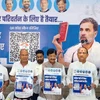
Bihar state Congress leaders during the launch of the QR code for applying for ticket. (Photo: @INCBihar)
4 min read Last Updated : May 25 2025 | 10:08 PM IST
The Assembly elections in Bihar are not due until October–November this year, yet political parties have already begun gearing up. In a first, the Congress has introduced a quick response (QR) code system to streamline the application process for prospective candidates.
A QR code — essentially a coded graphic that can be scanned using a smartphone — connects users to digital content. In the context of elections, it links physical materials with online resources, providing instant access to documents and data.
At a press conference in Patna earlier this month, Bihar Congress President Rajesh Ram outlined how the process would work: Aspirants no longer need to visit senior leaders to lobby for support. Instead, scanning the code leads them to a comprehensive application form that captures key personal details, constituency information, and party credentials.
“Candidates will be required to outline their association with the Congress, their membership status, and their involvement in campaigns such as ‘Har Ghar Jhanda’, accompanied by five photographs,” Ram said. The application also demands evidence of public engagement, including participation in Jan Aakrosh rallies, community meetings, social media outreach, and a full resume. “All MLAs, including sitting ones, must apply via the QR code and complete the form in its entirety. Applications will be assessed based on six distinct criteria,” he explained.
The QR code comes with a hopeful tagline: “Bihar is ready for change.” Within the party, however, doubts linger.
A senior Congress leader from Maharashtra, where the party suffered a heavy defeat in the recent assembly elections, offered perspective. “Whether in Bihar or elsewhere, political patronage and proximity to top brass often decide ticket distribution,” he said.
He described the process: The district unit usually forwards five-six names per constituency to the state unit. A Pradesh Election Committee (PEC), chaired by the state unit president, then reviews these. The number of recommended names can range from a handful to over 50. Based on the PEC’s suggestions, a shortlist is compiled and passed on to a Screening Committee, which includes at least one member from outside the state. This committee selects two or three names per constituency, which are then submitted to the Central Election Committee for final approval.
In practice, the leader admitted, inducements often mar the process. “Candidates offer inducements at each stage. This means viable contenders sometimes lose out. The QR system guarantees, at the very least, that each application is acknowledged by the party leadership.” The process becomes even more layered when seat-sharing within alliances is involved, adding weeks of negotiation.
One example cited by party insiders was of a former Pradesh Congress Committee chief who was removed after revelations that he struck a “disadvantageous” seat-sharing deal with ally Rashtriya Janata Dal (RJD) in 2020, allegedly to secure a ticket for his son — at the party’s expense.
Complaints about opacity in ticket distribution are not new. Ahead of the 2019 assembly polls in Haryana, then state unit president Ashok Tanwar protested outside party leader Sonia Gandhi’s residence, claiming tickets were sold off. “The Sohna seat was sold for Rs 5 crore,” he alleged. “If ticket distribution is unfair, how are our candidates expected to win?”
At the Congress’ special session in Burari in 2010, ordinary workers interrupted proceedings with slogans against the alleged “sale” of election tickets. And in 2008, former AICC general secretary Margaret Alva, seen as close to Sonia Gandhi, publicly criticised the party for ticket-related corruption after her son was denied one in Karnataka. She was swiftly asked to resign from all posts, including her seat on the Congress Working Committee, the party’s top decision-making body.
“Whether it’s QR codes or Google Forms, it still comes down to political judgement,” a former Union minister observed. “Digitising the application is the easy part. What matters is what happens after that.”
The increased use of digital tools within the Congress is widely attributed to strategist Sunil Kanugolu, known for his data-driven approach and sharp messaging. In 2023, he was said to be the brain behind the introduction of QR codes for party donations. They later featured in Congress campaigns in Karnataka (2022) and Madhya Pradesh (2023), where codes bearing the slogan “Pay the CM” were used to highlight alleged corruption under then BJP governments.
However, deploying QR codes to connect prospective candidates directly with the party apparatus is a first.




