Southern states reject population formula, seek GDP-based representation

Stalin said Tamil Nadu, which had effectively controlled its population through social welfare programmes, could lose at least eight LS seats if the current population-based formula were implemented

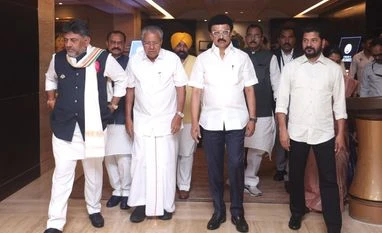
Chief Ministers of Kerala, Telangana, and Punjab -- Pinarayi Vijayan, Revanth Reddy, Bhagwant Singh Mann -- were part of the meeting. Deputy Chief Minister DK Shivakumar also attended the meet hosted by Tamil Nadu CM MK Stalin
Chief Ministers of Kerala, Telangana, and Punjab -- Pinarayi Vijayan, Revanth Reddy, Bhagwant Singh Mann -- were part of the meeting. Deputy Chief Minister DK Shivakumar also attended the meet hosted by Tamil Nadu CM MK Stalin.
Archis Mohan Delhi
6 min read Last Updated : Mar 23 2025 | 11:42 PM IST
On Saturday, a Joint Action Committee for Fair Delimitation (JAC), led by Tamil Nadu Chief Minister M K Stalin, passed a resolution at its meeting in Chennai, demanding that the “freeze on Parliamentary constituencies based on the 1971 Census population be extended by another 25 years”.
 
Apart from Stalin, the CMs of Kerala, Punjab, and Telangana, as well as the Deputy chief minister of Karnataka, attended the meeting. They cautioned that the impending delimitation of Lok Sabha seats, if carried out solely based on population, could “disempower” southern and other “progressive” states.
 
Stalin said Tamil Nadu, which had effectively controlled its population through social welfare programmes, could lose at least eight Lok Sabha seats if the current population-based formula were implemented.
 
Stalin rejected Union Home Minister Amit Shah’s recent assurance, made during his visit to the state, that southern states would not lose any seats “on a pro-rata basis” as “politically ambiguous” and lacking formal commitment. Shah had said the number of seats would not be reduced for any state and would be increased on a ‘pro-rata’ basis for all states, including those in the south. However, southern states have expressed uncertainty over whether this ‘pro-rata’ share would be based on their existing percentage of seats or on projected population figures.
 
Tamil Nadu, Kerala, and West Bengal, along with Puducherry and Assam, are scheduled for Assembly polls in April-May 2026. Despite being invited, the ruling Trinamool Congress in West Bengal skipped the meeting. The DMK also chose not to invite Hindi-belt constituents of the INDIA bloc, such as Bihar’s Rashtriya Janata Dal and Uttar Pradesh’s Samajwadi Party. Bihar is set for elections later this year, while UP goes to the polls in March 2027. West Bengal, Bihar, and UP are expected to gain seats in the proposed delimitation.
 
The YSR Congress Party of Andhra Pradesh has supported the DMK’s concerns over delimitation. Although the Telugu Desam Party (TDP), an ally of the BJP-led NDA government at the Centre, did not attend the meeting, Andhra Pradesh CM N Chandrababu Naidu has recently urged young married couples in the state to have more children. He has also indicated a willingness to amend state laws to encourage population growth and expressed concern over the state’s declining fertility rate.
 
Proposed reforms
 
At the JAC meeting in Chennai, Telangana CM Revanth Reddy urged the Centre to increase the Lok Sabha representation of the five southern states from the current 24 per cent to 33 per cent, aligning with their contribution to the country’s GDP. He said states contributing more to GDP should have a stronger voice in Parliament.
 
Karnataka Deputy CM and Congress leader D K Shivakumar suggested strengthening the Rajya Sabha, the Council of States, as a counterbalance to the numerical dominance of the Hindi belt in the Lok Sabha. Punjab CM Bhagwant Mann and Kerala’s Pinarayi Vijayan accused the BJP of “manipulating” seat allocation to benefit Hindi-speaking states, where the party performs well. Bharat Rashtra Samithi (BRS) leader K T Rama Rao proposed a permanent freeze on seat reallocation and argued that if the five southern states contribute 36 per cent of India’s GDP, they should receive 36 per cent representation in Parliament.
 
The JAC resolved to submit a joint representation to the PM during the ongoing Budget session of Parliament, pass resolutions against delimitation in individual state Assemblies, and establish legal panels to explore constitutional safeguards against “unfair” delimitation. The next JAC meeting is likely to be held in Hyderabad.
 
However, at the meeting of the Rashtriya Swayamsevak Sangh (RSS)’s highest decision-making body, the All India Pratinidhi Sabha, in Bengaluru, joint general secretary Arun Kumar dismissed the delimitation meeting in Chennai as politically motivated. “Neither has the Census begun, nor has the Centre initiated discussions over delimitation. Even the Act has not been drafted yet,” Kumar said, pointing out that the last delimitation took place in 1972 and that during Atal Bihari Vajpayee’s government in 2002, parliamentary seats were frozen until 2026. RSS sources indicated that population would likely be one of four criteria for delimitation.
 
The process
 
According to Article 81 of the Constitution, each state should receive seats proportionate to its population, with constituencies of roughly equal size. Parliament determines the allocation of seats for states or Union Territories (UTs) with a population below 6 million (as per the Thirty-First Amendment in 1973).
 
The Seventh Amendment (1956) capped the maximum number of elected seats at 520 — 500 from the states and 20 from UTs. Following adjustments under the Fourteenth Amendment (1962), the Thirty-First Amendment (1973), and the Goa, Daman, and Diu Reorganisation Act (1987), the Lok Sabha had a maximum sanctioned strength of 552 until 2019 (530 from the states, 20 from UTs, and two presidentially appointed Anglo-Indian members). The 104th Constitutional Amendment in 2019 removed the provision for Anglo-Indian representation. 
 
To ensure proportional representation, Article 82 mandates the reallocation of seats after every Census based on updated population figures. However, the Forty-Second Amendment, enacted in 1976 during the Emergency, suspended seat revision until after the 2001 Census. This was part of the Indira Gandhi regime’s efforts to promote family planning policies, ensuring that states that successfully controlled their population growth were not penalised. In 2002, Parliament further postponed reallocation through the Eighty-Fourth Amendment, extending the freeze until after the first decennial Census following 2026. This would have taken place in 2031, but the 2021 Census was delayed due to the pandemic.
 
Since 1971, southern states have witnessed fertility rates dropping below the replacement level of 2.1, while population growth has remained higher in states such as Bihar and UP. But persistent delays of the exercise have meant LS MPs now represent far more numbers than the 1 million threshold set by previous exercises. 
 
According to a 2019 study by Carnegie Endowment researchers Milan Vaishnav and Jamie Hinston, India’s Emerging Crisis of Representation, MPs in Uttar Pradesh represent nearly 3 million residents on average, making it the most under-represented state. In contrast, Tamil Nadu, “the most overrepresented state,” has MPs representing 1.8 million people on average.
 
Their projections, based on the 2011 Census, suggest that by 2026, Bihar, and Uttar Pradesh could gain 21 seats, while Kerala and Tamil Nadu might lose up to 16. If no state were to lose representation, the Lok Sabha would need to expand to 848 seats. However, even in this scenario, northern states would gain significantly more seats than southern states.

One subscription. Two world-class reads.

Already subscribed? Log in

Subscribe to read the full story →
*Subscribe to Business Standard digital and get complimentary access to The New York Times

Smart Quarterly

₹900

3 Months

₹300/Month

SAVE 25%

Smart Essential

₹2,700

1 Year

₹225/Month

SAVE 46%
*Complimentary New York Times access for the 2nd year will be given after 12 months

Super Saver

₹3,900

2 Years

₹162/Month

Subscribe

Renews automatically, cancel anytime

Here’s what’s included in our digital subscription plans

Exclusive premium stories online

  • Over 30 premium stories daily, handpicked by our editors

Complimentary Access to The New York Times

  • News, Games, Cooking, Audio, Wirecutter & The Athletic

Business Standard Epaper

  • Digital replica of our daily newspaper — with options to read, save, and share

Curated Newsletters

  • Insights on markets, finance, politics, tech, and more delivered to your inbox

Market Analysis & Investment Insights

  • In-depth market analysis & insights with access to The Smart Investor

Archives

  • Repository of articles and publications dating back to 1997

Ad-free Reading

  • Uninterrupted reading experience with no advertisements

Seamless Access Across All Devices

  • Access Business Standard across devices — mobile, tablet, or PC, via web or app

Topics :GDPsouth indiaSouthern RailwayDMKTelanganaKerala AssemblyKarnataka

Next Story