5 min read Last Updated : Nov 09 2025 | 11:52 PM IST
A local song that translates into “Keep quiet, don’t make a noise, the minister is sleeping” went viral in Uttarakhand, bringing home the point that the comforts of the ruling class were much more important than the aspirations with which the state was carved out of Uttar Pradesh (UP) on November 9, 2000. The song, released in the initial years of the formation of the state, reflects only a partial reality now as much water has flowed into the Gangotri-Yamunotri since then.
For instance, Uttarakhand’s economy gradually moved from below 1 per cent of India’s economy when the state was formed to over 1 per cent, ranging from 1.1 to 1.3 per cent. Similarly, per capita income in the state was less than the national average when the state was formed, but it went above all-India level in subsequent years. It has been 8-56 per cent higher than national level since then.
The state’s own tax revenues (OTR) have always been at least 30 per cent of its revenue receipts since its formation. However, the share rose higher than 31.9 per cent in 2000-01 subsequently, barring the Covid-hit year of 2020-21. Even then, the goods and services tax (GST) years are yet to bring the share back to the peak of over 40 per cent, witnessed a couple of years prior to the introduction of the new indirect tax regime.
The state government’s capital outlay has slowly started moving above 3 per cent of its gross state domestic product (GSDP) in recent years from 1 per cent when the state was formed, barring a bump in 2005-06.
This was also evident from the revenue and fiscal balance of the state. The state was revenue surplus for four years on the trot from the Covid year of 2020-21 and is anticipated to show the same results in FY25 and FY26 too. Its fiscal-deficit position was well within the limit of 3 per cent of GSDP barring two years — 2005-06 and 2017-18. This shows that the deficit incurred by Uttarakhand has been going to capital expenditure since FY21.
Even then, the capital outlay as a proportion of GSDP in Uttarakhand has mostly been less than the two other states carved out around the same time — Chhattisgarh and Jharkhand. For instance, it has been estimated to be 3.9 per cent and 4.1 per cent in Chhattisgarh, and 3.7 per cent and 4.1 per cent in Jharkhand for FY25 and FY26, respectively. This is so because the fiscal situation in Chhattisgarh was better and loans given by the government were less in Jharkhand than Uttarakhand for those years.
However, in terms of macroeconomic data such as per capita income, Uttarakhand has been in a much better position than the two states cited above. Per capita income in both the states has been less than the national average, unlike Uttarakhand.
In developmental aspects too, Uttarakhand has been doing much better than its contemporaries. For instance, the multidimensional poverty rate in Uttarakhand is 9.67 per cent as against the 14.96 per cent national average during 2019-21, while both Jharkhand and Chhattisgarh had a higher poverty rate than all-India level. Also, all districts in Uttarakhand except Haridwar had a lower poverty rate than the national average. That said, Uttarakhand has been witnessing a clash between economic development carried out in a hasty way, particularly in tourism, and the need to save the fragile environment of the Himalayan state. A flash flood sweeping away homes and hotels in Uttarkashi’s Dharali village is just one of the tragic examples.
Natural disasters such as landslides, cloudbursts, and floods, have taken the death toll much higher in 2023-24 and was equal in 2024-25 to that in UP despite the fact that the population in the former is just 5 per cent of that of the latter (estimated for 2024). Also the number of houses destroyed and cattle lost was much more in Uttarakhand than in UP in both the years.
While UP has controlled its plastic waste effectively, Uttarakhand saw it much more than the parent state for the first time in 2020-21, partly due to the mess created by tourists.
This clash was evident even when the economy moved at a snail’s pace in the Himalayan region in pre-Uttarakhand period, giving rise to “chipko” movement and anti-big dam protests. The clash has not stopped after the new state was born, even as the successive governments tried to address concerns relating to mega dams, and the forest cover rose from 64.8 per cent of the total state area in 2001 to 71 per cent in 2023.
ON STATE’S FORMATION DAY, PM LAUNCHES PROJECTS WORTH ₹8,260 CR
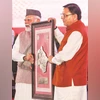
Prime Minister Narendra Modi (left) with Uttarakhand Chief Minister Pushkar Singh Dhami during the inauguration and foundation stone laying of various projects worth ₹8,260 crore on the occasion of Uttarakhand Formation Day, in Dehradun, on Sunday. The PM noted that work on infrastructure projects worth ₹2 trillion was underway in Uttarakhand and said the state’s Budget, which was only ₹4,000 crore 25 years ago, had now crossed ₹1 trillion. The projects inaugurated cater to several key sectors, including drinking water, irrigation, technical education, energy, urban development, sports, and skill development. The projects include Dehradun water supply coverage for 23 zones under the AMRUT scheme, an electrical substation in Pithoragarh district, solar power plants in government buildings, and AstroTurf Hockey Ground at Haldwani Stadium in Nainital, among others.
“The true essence of uttarakhand lies in its spiritual power. if it resolves, it can establish itself as the spiritual capital of the world in the next few years.”- Narendra Modi, Prime Minister