Bihar's Mithila painting struggles amid eroding local political backing

Despite global acclaim, Bihar's traditional painting cries for help amid eroding local political backing. Aashish Aryan reports from Darbhanga
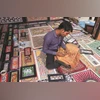
Madhubani Paintings
Madhubani Paintings | File Image
Aashish Aryan New Delhi
4 min read Last Updated : Nov 09 2025 | 10:47 PM IST
For an art form rediscovered by English officer William G Archer and his wife, Mildred Archer, following the devastating Nepal–Bihar earthquake of 1934, the Madhubani or Mithila painting has travelled far beyond the borders of Bihar over the past nine decades.
 
Practised mainly by women trained by other women, often their mothers or mothers-in-law, this labour-intensive art form takes pride in packing as many intricate details as possible onto a single canvas.
 
The painting style has found ardent admirers, including Finance Minister Nirmala Sitharaman, who wore a saree adorned with Mithila paintings while presenting the Union Budget for 2025-26.
 
However, most achievements in this art form have been realised without much institutional or government support, according to practising artists.
 
Consider Jitwarpur, a small village in Madhubani with a population of roughly 10,000. Nationally and internationally renowned Mithila painting artist Sita Devi hailed from this village. To this day, most families here, including men and children, continue to make Madhubani paintings.
 
“As far as state support is concerned, there is hardly any. Holding a state-backed exhibition for a week or a fortnight once a year is hardly enough for an artist to sell and sustain for the next 50 weeks,” said Sawan Kumar Jha, an artist.
 
A resident of Jitwarpur, Jha laments that the cultural, artistic, and culinary richness of Bihar has been steadily eroding in the absence of political backing.
 
Jha, his mother Anita Devi, and his sister Damini, along with 400 other women from Jitwarpur, create these paintings, while his father and a few other men handle the logistics. They sell these paintings at various exhibitions across the country, including the Kala Ghoda Art Festival and the INA's Delhi Haat.
 
Madhubani district, where Jitwarpur is located, goes to the polls on November 11. The neighbouring town of Darbhanga, which shares a similar political culture, voted in the first phase on November 6.
 
“My mother learnt this art form from my grandmother, who practised it on walls and murals. Since then, we have participated in exhibitions across the country independently,” he said.
 
Earlier, politicians made promises to support Madhubani painting artists as elections approached. But over time, even those promises have faded, Jha added.
 
“Who talks about the legacy of Darbhanga Maharaj or his riches, his philanthropy, the various institutions he has helped build all around the country and world? He is not remembered even during elections,” he said.
 
The lack of political support and institutional apathy is not limited to Mithila paintings alone, said Arti Jha, founder of Sakhi Bahinpa, a women’s collective and non-governmental organisation working to preserve the culture of the Mithilanchal region.
 
“For the language to be revived, Maithili must be taught in schools. Only then will the unique culture of Mithilanchal survive the onslaught of modernisation,” Jha said. Founded a decade ago, Sakhi Bahinpa, which translates to “circle of friends and sisters”, now has over 40,000 members across India and Nepal.
 
Apart from preserving the language, which has its own script, the government must also ensure that ponds crucial to the production of makhana (fox nuts) are protected from encroachment, she added.
 
“Unchecked development is rampant across the twin cities of Darbhanga and Madhubani. Several ponds have been filled overnight with soil to make way for buildings,” Jha said.
 
While there has been some progress, such as the establishment of a Mithila Haat at Jhanjharpur, much more remains to be done, she said.
 
“There must be institutional backing to define and preserve the contours of Mithila painting,” she said, lamenting that untrained individuals were teaching the art online for quick money and easy profit.
 
All is, however, not lost for Mithila artists, who occasionally find work through government programmes, said Sudha Mishra, founder of the Darbhanga-based Mithila art company Pihu Art and Craft.
 
“For example, right now we have been painting election booths, poll flyers, and other campaign material for several politicians and parties. There’s some work and business to attend to. But the problem is, all this support and work will vanish soon after the elections,” Mishra said.

One subscription. Two world-class reads.

Already subscribed? Log in

Subscribe to read the full story →
*Subscribe to Business Standard digital and get complimentary access to The New York Times

Smart Quarterly

₹900

3 Months

₹300/Month

SAVE 25%

Smart Essential

₹2,700

1 Year

₹225/Month

SAVE 46%
*Complimentary New York Times access for the 2nd year will be given after 12 months

Super Saver

₹3,900

2 Years

₹162/Month

Subscribe

Renews automatically, cancel anytime

Here’s what’s included in our digital subscription plans

Exclusive premium stories online

  • Over 30 premium stories daily, handpicked by our editors

Complimentary Access to The New York Times

  • News, Games, Cooking, Audio, Wirecutter & The Athletic

Business Standard Epaper

  • Digital replica of our daily newspaper — with options to read, save, and share

Curated Newsletters

  • Insights on markets, finance, politics, tech, and more delivered to your inbox

Market Analysis & Investment Insights

  • In-depth market analysis & insights with access to The Smart Investor

Archives

  • Repository of articles and publications dating back to 1997

Ad-free Reading

  • Uninterrupted reading experience with no advertisements

Seamless Access Across All Devices

  • Access Business Standard across devices — mobile, tablet, or PC, via web or app

Topics :Bihar Election 2025 NewsBihar governmentartsPaintingsCulture Ministry

Next Story



