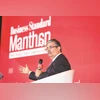
The answer to the current account deficit (CAD) is domestic competitiveness and India needs to improve its ROTI (return on time invested), said Uday Kotak, founder and director of Kotak Mahindra Bank, on Thursday.
Speaking at the second edition of the annual Business Standard summit, Manthan, in New Delhi, Kotak also said India should have a global consumer brand in five years that customers in any country can recognise, similar to Apple in the US.
Commenting on India’s CAD, which stands at a modest 1.2 per cent of the gross domestic product, Kotak said the trade mix reveals a $40 billion surplus with the US but an $80 billion deficit with China.
“What are we going to do about the mix of our current account, especially if the US wants to equalise? Some of it will be substitution, but some of it may have a net impact,” Kotak said.
“The answer to CAD is ultimately domestic competitiveness,” he said, adding that India needs to focus on two things and one of them is productivity. “India can dramatically improve its ROTI, that is, return on time invested,” Kotak said. The second area, Kotak said, is competitiveness. He said India has a long innings of protectionism, and going ahead, there would be a lot of distressed producers around the world. India needs to think how to take advantage of that without destroying domestic industries. “That is a part of policy opportunity and challenge.”
He also advocated for building defence capabilities within India, calling it an important national priority.
“In this world with significant breakdown, I actually encourage India, an Indian business, to build defence in India. Because the moment you are not building that capability, you are dependent on some other country, with whom you may have good relations today, may not be so great tomorrow. Therefore, how fast we can build, in my view, should be a very important priority for our country,” he said.
Kotak also believes that India needs to build consumer brands in the next five years that would be recognised globally. “We need to build global consumer brands. I would love to see a few global Indian brands, which everybody from Bolivia to China will recognise,” he said, adding that India must focus on quality and desire to create world-class brands. “India has a very big advantage of the domestic population and that should not make us complacent to be truly outstanding in excellence and quality,” Kotak said.
According to Kotak, India should have a strategy to counter outflows. If US interest rates remain at 4.5 per cent and the dollar continues to be the dominant currency, there will be outflows.
“The total stock of capital repatriable assets, which India has attracted today, is about $2.5 trillion… The key question is, if US interest rates remain around 4.5 per cent for long term and dollar becomes the continuing dominant currency in the Trump world, India must have strong game plan such that if a small percentage of $2.5 trillion has an exit, what would be our counter measures from a policy point of view,” Kotak said.
India will have to choose between using its foreign exchange reserves or allowing the market to find its own level. If India decides to use its reserves, it has to ensure adequate domestic liquidity, Kotak said. “India’s net foreign exchange reserves are very comfortable at $550 billion to $600 billion.”
He also pointed out that one of the biggest challenges for the global economic order today is that politics is playing a much larger role in shaping financial markets and economies. After World War-II, politics was a relatively minor factor, but it has now become a significant influence.
Kotak highlighted that while it’s encouraging to see the Indian saver transition into an investor in recent years, many invest without fully understanding the valuations at which their SIPs (systematic investment plans) are being made. He said that the Indian markets will eventually reach a point where valuations become very attractive, presenting a significant opportunity.
Kotak advised the banking sector to rethink its approach. Rather than following the traditional model of banking, financial institutions should look at providing solutions to the customers in a holistic manner, which takes care of both their savings and investing needs. “In a world where you have a significantly higher interplay of saver and investor, you have to look at banking from a new lens. If you keep on flagging them for deposits when they want to put money in equities, it is not going to work,” he said, adding that the future of banking rests on providing solutions for the customers.
Kotak said physical banking is still not dead because of trust but it is going to get much slower in terms of its share. He also stressed that if India were to break into the top three economies in the world in the next few years, India’s financial sector has to pull a lot more weight than it is pulling now. When asked about key steps the government should take to revive economic growth, Kotak said he would love to see Indian enterprises get their animal spirits back.
Kotak suggested that the next generation of Indian family-owned businesses, who have sold their businesses and deployed the capital in equity markets, should instead look to use that capital to support new ventures or build new businesses.
(Disclaimer: Entities controlled by the Kotak family have a significant holding in Business Standard Pvt Ltd)

 "BS Manthan: Domestic competitiveness answer to CAD, says Uday Kotak")

