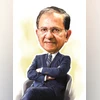
Suresh Narayanan's journey: From Maggi crisis to Nestle India's growth

Breakfast with BS: Suresh Narayanan, Chairman & MD, Nestle India says Legacy brands can't rely on their past anymore. The challenge now is to stay relevant, be as nimble as startups, regional players

Suresh Narayanan, Chairman & Managing Director, Nestle India | Illustration: Binay Sinha
Akshara Srivastava
6 min read Last Updated : Jul 27 2025 | 10:45 PM IST
Some people are meant to deal with storms. Suresh Narayanan is one of those people. When I meet him on a monsoon morning, I try to look for the traces that years of crisis management might have left on his face. All I see is a smile.
 
I have chosen a quiet corner at the Oberoi’s all-day diner, Threesixtyone Degrees, in Gurugram for the breakfast meeting with Nestle India’s outgoing chairman and managing director. On July 31, Narayanan will vacate the corner office he had moved into 10 years ago — in the middle of a storm (of course).
 
The Food Safety and Standards Authority of India had ordered a nationwide recall of Nestle’s wildly popular Maggi noodles over concerns about high levels of lead and misleading labelling regarding monosodium glutamate content.
 
The company initially went into denial mode, inviting further criticism and the controversy impacting its share price. But then it quickly course-corrected. It voluntarily recalled the noodles from the market, submitted samples to independent laboratories, challenged the ban in court, and opened more communication channels with consumers.
 
Today, India is the biggest market for Maggi noodles worldwide. Earlier this month, the company set up a new line at its Sanand factory in Gujarat to jack up Maggi noodles’ annual production by 20,300-odd tonnes. 
 
On that note, we order coffee: Americano for him and a cappuccino for me.
 
Narayanan, 65, has been with Nestle for 26 years, starting out in India but later moving to Singapore as managing director — a three-year stint marked by the collapse of the Lehman Brothers. In 2010, he moved to Egypt, where (no, the Nile didn’t change course) the Arab Spring broke out. From there, he moved to the Philippines for four months, before returning to India.
 
The challenges-riddled path has taught him the essentials a leader must possess for managing a crisis: An unwavering sense of values and purpose; the ability to accurately identify the crisis; and to develop a series of action plans with a few quick wins to dispel the doomsday feeling.
 
“A leader owes it to people to give them an assurance of jobs and livelihood. It’s important to communicate with colleagues, employees, and the media,” he says with a gentle smile. “A crisis is not the time to clam up because remaining silent is tantamount to being complicit.”
 
Still, when he was asked to move to India, the question crossed his mind: 
 
Why me?
 
“My father said, ‘You don’t send an i***t into a crisis. You send someone you trust to help get you out of it.’ Some days were difficult, but a leader must swallow those bitter pills himself,” he says. “The team here was very trusting, and I took to the company like a duck to water.”
 
Now, after leading the brand’s revival, Narayanan is preparing for his second innings. “I’m excited; it’ll help me discover new passions,” he says. Among those passions are reading, tennis, and poetry. At the company’s annual general meetings, he often quotes Kabir.
 
This next chapter also brings a sense of calm. “It’s how the corporate world works,” he shrugs. “I look forward to days where I do absolutely nothing. It’s inconceivable in my current role, but in the next phase, that’s a perfectly legitimate desire,” he adds with a chuckle.
 
He’s headed to Bengaluru, but there are still boxes to tick. Travel and teaching top the list. “Teaching is something I’ve always enjoyed. I’m exploring options — maybe a full course, maybe guest lectures. That, along with family, should keep my days full.”
 
There’s also talk of a book. “People keep suggesting it. I’m still wondering whether I really have a story to tell, but it’s not improbable.” 
 
Before we go further, I remind him to eat something. He orders a well-done egg-white omelette with onions, coriander, and chili — “no mushrooms or tomatoes” — plus brown toast. “I’ll go easy on lunch,” he smiles. I order eggs benedict, but barely touch it as the conversation deepens.
 
Narayanan began his career 44 years ago in the consumer goods sector as a management trainee at Hindustan Unilever — then Hindustan Lever (HLL). But it wasn’t part of the plan.
 
“My ambition was to become an IAS officer. That’s why I studied economics; I never even attempted the CAT,” he recalls. But in 1981, when HLL came to the Delhi School of Economics for placements, he was persuaded to sit for the interview.
 
“I wasn’t serious, but got through the first round. Then I cheekily asked them to cover my airfare to Bombay for the final round — and they agreed! I was totally bindaas, and somehow made it. After that, I never wrote the IAS exam.”
 
Some 17 years later, he moved to Colgate for a year before joining Nestlé. “At Hindustan Lever, I’d worked in food, and that’s what interested me. Colgate is a great company, but selling toothbrushes didn’t excite me.”
 
Over the years, Narayanan has witnessed the Indian consumer’s transformation. “I started in the license raj era. Brands were limited and access defined success. Premium was barely a concept.”
 
Over time, media, travel, and especially social media, helped bridge the gap between premium and mainstream, exposing consumers to new experiences and greater choice. Post-Covid, health has taken centre stage.
 
“Legacy brands can’t rely on their past anymore. The challenge now is to stay relevant, be as nimble as startups and regional players,” he says.
 
Despite progress, the urban-rural divide remains. “Aspirations may now be synchronous, but they weren’t always,” he says. “This gap adds richness to our consumption landscape. The real shift will come from rising per capita income. That’s when consumption will really take off.”
 
He believes the Indian consumption story remains strong. “The texture of consumption is changing. It’s an exciting space. Premiumness — in both product and experience — will matter more, along with constant innovation. Consumers are looking for newness.”
 
As he finishes the last bite of his omelette and declines more coffee, I ask: Does he use Nestle products himself?
 
“Many,” he replies. “Nescafe and Nescafe Gold, the A+ dairy range, Maggi, KitKat — though KitKat’s frequency has gone down over the years.”
 
On that sweet note, the conversation winds down. Narayanan gets up, offers a warm handshake, and walks away with a smile — a presence that will be missed at quarterly roundtables.

One subscription. Two world-class reads.

Already subscribed? Log in

Subscribe to read the full story →
*Subscribe to Business Standard digital and get complimentary access to The New York Times

Smart Quarterly

₹900

3 Months

₹300/Month

SAVE 25%

Smart Essential

₹2,700

1 Year

₹225/Month

SAVE 46%
*Complimentary New York Times access for the 2nd year will be given after 12 months

Super Saver

₹3,900

2 Years

₹162/Month

Subscribe

Renews automatically, cancel anytime

Here’s what’s included in our digital subscription plans

Exclusive premium stories online

  • Over 30 premium stories daily, handpicked by our editors

Complimentary Access to The New York Times

  • News, Games, Cooking, Audio, Wirecutter & The Athletic

Business Standard Epaper

  • Digital replica of our daily newspaper — with options to read, save, and share

Curated Newsletters

  • Insights on markets, finance, politics, tech, and more delivered to your inbox

Market Analysis & Investment Insights

  • In-depth market analysis & insights with access to The Smart Investor

Archives

  • Repository of articles and publications dating back to 1997

Ad-free Reading

  • Uninterrupted reading experience with no advertisements

Seamless Access Across All Devices

  • Access Business Standard across devices — mobile, tablet, or PC, via web or app

Topics :breakfastNestle MaggiFMCGNestle India

Next Story