Country needs to push for 'Heal in India', says Apollo's Prathap C Reddy

Coffee with BS: Meet Prathap C Reddy, founder-chairman, Apollo Hospitals
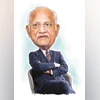
Prathap C Reddy, founder, Apollo Hospitals.
Shine Jacob Chennai
7 min read Last Updated : Oct 03 2025 | 11:03 PM IST

Don't want to miss the best from Business Standard?

At the Apollo Hospitals corporate office, Sunny Side Building, in the heart of Chennai, as I wait for Prathap C Reddy to meet me, my mind races with questions. I am still thinking of them when the 92-year-old walks into the room, greets me warmly, and takes a seat.  
Ninety-two years is a long time. Where does one even begin asking about them? But then, 92 years can give you the ability to read people’s minds. The founder-chairman of Apollo Hospitals astutely gauges my predicament, and decides to begin at the beginning — from his village, Aragonda, in the Chittoor district of Andhra Pradesh, which has three temples, dedicated to Parameshwara, Rama, and Hanuman, but back in the day had no school. 
Reddy would have a tutor teach him at 3 pm every day. But before those special classes, he and a group of some 10 friends would climb atop a hill in the village and jump into a water body 20-ft down. Perhaps, behind those heroics was the conviction that no harm would come to them even if they went into freefall from that height. After all, Reddy’s was no ordinary village. Legend had it that when Hanuman was transporting the mountain with the sanjeevani booti (life-reviving herb) to save Laxman, half of that mountain fell in this village. Perhaps, it was then destined that Reddy would choose a profession that involved healing. 
Decades later, in March 2000, America’s then president Bill Clinton would inaugurate the world’s first V-SAT-enabled telemedicine centre at Aragonda. He would watch a doctor consulting a child from the village with heart disease and assuring her that she would lead a normal life. Describing it as a “wonderful contribution to the healthcare of people who live in rural villages,” Clinton had said to Reddy: “... I hope that people all over the world will follow your lead.” 
As he recounts the event, Reddy searches for photographs from that day in a book. Flipping through its pages, he smiles as he points to some pictures: “This was in my village, Aragonda.” 
Apollo has since had many firsts: The first CT scan, the first MRI, the first proton therapy centre… 
We are meeting over coffee. Reddy has an extra small cup. “Whenever I drink coffee, I take only half of this cup,” he says. Strict dietary discipline is what keeps him going. His day begins at 6.30 am, followed by a walk, a bath, and then one-and-a-half hours of prayers, during which he reads Sundara Kanda, the fifth book in the Ramayana.  
“I used to love tennis,” he says. “I never missed a Wimbledon semi-final or final for years. 
Mornings now include fruits; lunch is rice and a piece of fish; and dinner is roti with curd. “I love curd,” he says with childlike joy.
From his village, Reddy went on to get a degree in medicine from Stanley Medical College in Chennai, and later trained as a cardiologist in the UK and the US. A fellowship at the Massachusetts General Hospital in Boston followed, and then he headed several research programmes at the Missouri State Chest Hospital. In 1971, he returned to India at the behest of his father who wanted him to serve in India.  
Eight years later, the death of a 38-year-old heart patient who could not travel abroad for treatment got him thinking about setting up a hospital that would address such a challenge. 
The first Apollo hospital was born in 1983, at Chennai’s Greams Road. The name “Apollo” came from his daughter, Suneeta Reddy, who suggested they name it after the Greek god of healing.  
It wasn’t all smooth, though. Getting loans for healthcare wasn’t easy in the time of Licence Raj, and medical equipment was treated as luxury goods, with higher import duties. A meeting with Indira Gandhi, then prime minister, helped get the proposal for the hospital cleared. 
Today, Apollo has 73 hospitals, over 10,400 beds, 6,600 pharmacies, 264 clinics, 2,182 diagnostics facilities, and 800 telemedicine centres. It has presence in 25 countries, including the UK, Mauritius, Egypt, Barbados, Bangladesh, Vietnam, Fiji, Bahrain, and Nigeria. There are upcoming projects in Sri Lanka, Ethiopia, Kenya, United Arab Emirates, Saudi Arabia, Samoa, and so on. 
Reddy’s four daughters – Preetha Reddy, Sangita Reddy, Suneeta Reddy, and Shobana Kamineni – are all involved with Apollo Hospitals in various capacities.  
Our conversation is interrupted by a member of Reddy’s staff, who approaches him with a note. He has a board meeting to attend in one of the coming days. This was proof of him being actively involved in the day-to-day affairs of the group.  
Reddy has the kind of presence that fills the room — someone you’d consider making a biopic on. If such a film were to be made, who would play Reddy? “Ram Charan?” I suggest. He laughs out loud. The Telugu superstar is his grandson-in-law. “Do you know Ram Charan is my kid?” he says, sidestepping the question. But the question has put him in the mood to talk about his family. “I have 10 grandchildren, and 14 great-grandchildren. On Sundays, they visit me, and they play with me for a long time,” he says, crediting his wife, Sucharitha, for keeping the family so closely together. 
From family, the discussion moves to technology and artificial intelligence. He points to the statues of Apollo and the Greek goddess, Athena, on his table. “We came up with a women’s cancer hospital and preventive care, and called it Athena (after the patron and protectress),” Reddy says. 
“In the US, if you want to see a doctor, it takes two weeks. For an MRI, another two. To see a specialist, add two more. My wife’s sister had back pain — it took her three months to finally get the surgery. In India, it happens within hours,” he says, stressing the need to promote “Heal in India”. 
Reddy believes artificial intelligence (AI) has transformed patient care by bringing precision and urgency to the forefront. “Reading an X-ray used to take 20 minutes. Now it’s 20 seconds. AI has brought a tremendous shift in healthcare. We were the first to make full use of it,” he says. Apollo, through its pro-health programme powered by AI, has conducted more than 25 million health checkups so far. 
Asked about what disappoints him, he admits the shift from illness to wellness has been slower than expected. “I spend more time on preventive health than curative health now. Noncommunicable diseases are killing people. We must prevent that,” 
he says. 
I press about his taste in films. He smiles and concedes he is not much of a moviegoer — the last one he watched was RRR. “I want everyone to focus on HHH — Health, Happiness @ Home. I put that first.” Then, turning reflective, he adds: “From a small micro sperm, God has developed all this. We should take care of that health.” 
As we wrap up, unlike the usual industrialist, he insists on a photograph. As the shutter clicks, he  clasps my hand warmly. The calmness in his handshake is a reminder that, for him, healthcare is as  much about human touch as it is about technology.

One subscription. Two world-class reads.

Already subscribed? Log in

Subscribe to read the full story →
*Subscribe to Business Standard digital and get complimentary access to The New York Times

Smart Quarterly

₹900

3 Months

₹300/Month

SAVE 25%

Smart Essential

₹2,700

1 Year

₹225/Month

SAVE 46%
*Complimentary New York Times access for the 2nd year will be given after 12 months

Super Saver

₹3,900

2 Years

₹162/Month

Subscribe

Renews automatically, cancel anytime

Here’s what’s included in our digital subscription plans

Exclusive premium stories online

  • Over 30 premium stories daily, handpicked by our editors

Complimentary Access to The New York Times

  • News, Games, Cooking, Audio, Wirecutter & The Athletic

Business Standard Epaper

  • Digital replica of our daily newspaper — with options to read, save, and share

Curated Newsletters

  • Insights on markets, finance, politics, tech, and more delivered to your inbox

Market Analysis & Investment Insights

  • In-depth market analysis & insights with access to The Smart Investor

Archives

  • Repository of articles and publications dating back to 1997

Ad-free Reading

  • Uninterrupted reading experience with no advertisements

Seamless Access Across All Devices

  • Access Business Standard across devices — mobile, tablet, or PC, via web or app

Topics :BS SpecialDr ReddyApollo HospitalsApollo Hospitals Enterprise

Next Story


