Home / Sports / Football News / Violence has taken away my house, everything we had: Indian footballer
Violence has taken away my house, everything we had: Indian footballer
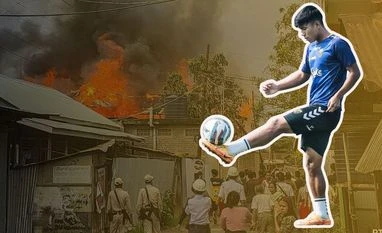
I heard the news of our house being torched and then the football turf that I built in Churachandpur was burnt, it was really heartbreaking, says India footballer Chinglensana Singh
Relieved at having his family around, Chinglensana Singh is now thinking of ways to overcome the profoundly disturbing experience, and start afresh.
3 min read Last Updated : Jul 31 2023 | 9:23 AM IST
It was a humid May evening as usual in Kozhikode, as India footballer Chinglensana Singh ambled down the ground to enter the dressing room. Once there, he saw a trail of text messages and a barrage of missed calls on his phone.
Worried, he promptly tried returning the calls but to no avail. But soon the centre-back from the strife-torn state found out that he had lost almost everything in the violence that broke out there on May 3, the same day that he was representing Hyderabad FC in an AFC Cup playoff (Asian continental tournament) match against Mohun Bagan in faraway Kozhikode.
"It has taken away everything from us, everything we earned, everything we had," the player, hailing from Khumujama Leikai in Churachandpur district, told PTI.
"I heard the news of our house being torched and then the football turf that I built in Churachandpur was burnt. It was really heartbreaking.
"I had the big dream of providing a platform to the youngsters but it was taken away. Fortunately, my family escaped the violence and was shifted to a relief centre," he added.
After trying for a while, when the 27-year-old finally managed to get in touch with his mother, wailing at the other end amid the sound of gunshots in one of the epicentres of the violence, he immediately decided to go back to his parents.
He couldn't delay any longer, as the clashes had by then destroyed his house, ravaged his village, and dashed his hopes of giving wings to aspiring footballers' dreams. Only his family survived.
Relieved at having them around, he is now thinking of ways to overcome the profoundly disturbing experience, and start afresh.
"I always had a big dream of providing a platform to the youngsters in Churachandpur who are talented but they couldn't afford to enrol in a football school.
"My aim was to provide them a platform, to help them become professional players and then go on and play for the national team... become great players for the country. Then this incident happened, so everything is being robbed. But we will try to start again."
The violence was sparked by a court ruling in March that granted the majority Meitei scheduled caste status, entitling them to the same economic benefits and quotas in government jobs and education as the minority Kuki.
It also allowed Meiteis to buy land in the hills, where the Kukis predominately live, further fuelling fears that their lands, jobs and opportunities would be taken away.
Tension escalated in the northeastern state when a video of May 4 emerged on social media, showing men from one community parading two women naked from the opposing side.
(Only the headline and picture of this report may have been reworked by the Business Standard staff; the rest of the content is auto-generated from a syndicated feed.)


 "Violence has taken away my house, everything we had: Indian footballer")

