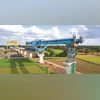
Work to build the 508-km long Mumbai-Ahmedabad High Speed Rail (MAHSR), or the bullet train as it is popularly called, is progressing well and 48.55 per cent of the project was completed in January.
Larsen & Toubro (L&T), the primary contractor responsible for 92 per cent of the construction, is using artificial intelligence (AI), machine learning (ML), new survey techniques, and robots for efficiency, accuracy and safety.
Of the 466 km of the project being executed by L&T (331 km in Gujarat and 135 km in Maharashtra), 318 km (68 per cent) in Gujarat will be handed over to other contractors by December 2025.
Advanced technologies have helped the project in several ways: Reducing survey time from 60 days to 15, analysing the impact of labour and equipment, optimising asset management, ensuring precision, and improving safety.
“The integration of AI, ML and robotics in the MAHSR project plays a crucial role in enhancing efficiency, accuracy, and safety throughout the construction and survey processes,” said S V Desai, whole-time director and senior executive vice-president, civil infrastructure, at L&T.
Quality automated
“These technologies collectively improve efficiency, reduce costs, and enhance overall project outcomes by automating repetitive tasks, providing real-time insights and maintaining high-quality standards,” he said.
L&T’s scope of work includes constructing civil and building structures for the double-line project, covering viaducts, bridges, maintenance depots, tunnels, and railway stations before handing them over to other contractors.
LiDAR, short for light detection and ranging technology, was used for the first time in a project for the Indian Railways. The remote sensing method employs laser pulses to analyse the Earth's surface, providing highly accurate, three-dimensional information about topography and surface characteristics.
LiDAR significantly accelerated project execution, enabling a topographical survey of 118.55 sq km in just 15 days: A task that would have required 60 days using conventional methods.
“This technology offers multiple advantages, including pinpoint accuracy, rapid data acquisition, minimal human intervention, independence from weather conditions, high data density, broad accessibility, and cost efficiency,” said Desai.
“By using lasers mounted on a fixed-wing aircraft, supported by precise GPS and INS, LiDAR captures data at 0.5-metre intervals to generate detailed topographic features, providing a comprehensive understanding of the surveyed area. Additionally, it is environmentally friendly." GPS (Global Positioning System) and INS (Inertial Navigation System) are two navigation technologies.
To improve productivity in a precast factory for bridges and viaducts, L&T used technology that deploys AI to track time spent on activities and assess the impact of labour and equipment. AI was also used to measure process timestamps for various components.
AI also provides interactive visualisations of data points and generates downloadable reports in Excel and PDF formats. Key parameters displayed include production count, duration of tasks, vendor-wise productivity, and asset utilisation.
By analysing historical usage patterns, AI generates recommendations on whether to retain, redeploy, or rehire assets, ensuring efficient resource allocation and cost reduction. Alerts are triggered based on past usage analysis, tolerance thresholds, and historical variations, enhancing asset management efficiency.
Virtual reality (VR) played a vital role in safety training through 16 specialised modules. These modules educate engineers and workers on the importance of safety.
VR creates an immersive, risk-free training environment where users can experience real-life hazards and learn safety protocols. This hands-on approach improves knowledge retention, enhances emergency response, and reduces workplace accidents, according to L&T. By simulating real-world risks, VR ensures better preparedness and safety training.
Setting the bar
Precision and safety are further strengthened by advanced robotics. A robotic rebar cage manufacturing unit (RRCM) integrates handling robots, welding robots, a robotic positioner, automated feeding stations, feeders, sorters, and conveyor systems to automate the production of rebar cages, which are used to reinforce foundation beams in a construction project.
RRCM ensures precise synchronisation of four robotic arms used for welding and pneumatic fixtures that grip different rebar shapes. RRCM boosts efficiency by producing 25,000 rebar cages monthly, reducing wastage by 99.99 percent and enhancing safety by minimising manual intervention. It lowers environmental impact by cutting carbon emissions. The Parliamentary Standing Committee on Railways noted in March that the total cost of the MAHSR project is estimated at ₹108,000 crore, with ₹71,116 crore already spent as of January 2025.
With seven new bullet train projects planned, advanced technologies in construction could revolutionise India’s infrastructure development.