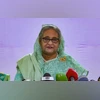
Bangladesh Prime Minister Sheikh Hasina called an emergency meeting with university vice chancellors and college principals on Saturday night amid heightened tensions as student movement leaders refused her invitation for talks and demanded her resignation, days after over 200 people died in anti-quota protests.
Bangladesh recently witnessed violent clashes between the police and mostly student protesters demanding an end to a controversial quota system that reserved 30 per cent of government jobs for relatives of veterans who fought in Bangladesh's War of Independence in 1971.
The prime minister held a "view-exchange meeting with the vice-chancellors of public and private universities, senior teachers and college principals at Ganobhaban (PM's official residence), a PMO spokesman said.
Without giving any detail, he said the meeting discussed the overall situation created over the students' campaign and the way out to overcome it, while the teachers vowed to work in unison to save the students from the clutches of the evil forces.
The nearly three hour-meeting started at around 8:15 pm (BST) after tens of thousands of students, their guardians and ordinary people joined a mammoth protest rally at Central Shaheed Minar in Dhaka against the killings and mass arrests over quota system for government jobs.
The protestors chanted anti-government slogans, some calling for the resignation of Prime Minister Sheikh Hasina while identical protests were staged in several other major cities amid reports of scattered clashes.
The protest leaders called for an all-out civil disobedience movement from Sunday and asked officials and law enforcement agencies to stand by them instead of the government.
The government leaders earlier said the students peaceful campaign was hijacked by fundamentalist Jamaat-e-Islami and their student front Islami Chhatra Shibir being backed by ex-premier Khaleda Zia's BNP.
In an executive order on Friday the government banned Jamaat and its front organizations.
In clear terms, we want to say we don't care what is (ruling) Awami League, (main opposition outside parliament) BNP or Jamaat. Our (students) bonding is unbreakable, one of the key-protest coordinators Nahid Islam told the rally.
He called the incumbent government fascist for its repressive role to tame their justified campaign and announced the students would present a national framework of future Bangladesh after consultation with all stakeholders.
We announce the abolition of the government and the fascist regime. That's why we call for a student uprising. We want to build a Bangladesh where autocracy will never return. Our sole demand is the resignation of this government, including Sheikh Hasina, and the end of fascism.
The government now says the gates of Ganabhaban are open for talks. We believe she (Sheikh Hasina) has already understood that the doors of Ganabhaban must remain open. We demand Sheikh Hasina's resignation, including the entire cabinet. Not only should she resign, but she should also be brought to justice for all the murders and disappearances in the country," he said.
Witnesses said the protesting students blocked major thoroughfares of the capital, causing traffic halts, while police and paramilitary troops kept a vigil.
Coordinators of the Anti-Discrimination Student Movement announced their one-point demand and gave a 24-hour ultimatum to reopen all university dormitories as authorities ordered closure of all schools, colleges and universities for indefinite period to tame the street campaign.
Authorities earlier enforced nationwide curfew calling out army troops as paramilitary BGB appeared inadequate to support the police in handling the situation.
Army chief General Waker-uz-Zaman held a meeting with all military officers in Dhaka in-person and cantonments outside through conference calls and urged them to perform duties with patience and restraints.
On Friday, Prime Minister Hasina urged the agitating students to meet at her Ganabhaban official residence for talks to end the violence over the quota system in government jobs.
Her call came a day after new protests erupted on Friday, leaving two people dead and more than 100 injured as over 2,000 protesters gathered in parts of the capital, some shouting down with the autocrat and demanding justice for victims.
I am saying again, they (student leaders) can come to me for talks if they want they can bring with them their guardians as well anytime, she said during a meeting with leaders of different professional groups.
The door of Ganabhaban is open (for them), she said.
"I want to listen to them. I do not want conflict," she said while ruling Awami League sources said three party leaders were tasked to communicate and convince the anti-quota movement coordinators.
Meanwhile, two police officials were suspended by higher authorities for their unprofessional conduct. The officials fired gunshots that killed a second-year student of Northwestern Rangpur University Abu Sayeed, the first casualty during the protest on the university campus, intensifying the student's rage.
Video footage and photos showed Sayeed standing, arms spread wide, alone, challenging the police crackdown against protesters when a police officer suddenly shot him several times.
However, coordinators of the Anti-Discrimination Student Movement said on Friday that they had no plan to hold talks with the government, and overnight, they called a nationwide street protest and all-out non-cooperation or civil disobedience campaign.
One of the six coordinators who were earlier detained for their own safety in detective police custody and freed after they announced the withdrawal of their movement on Friday said they were forced to give the statement.
"When we were detained in the office, we were asked to meet with the Prime Minister and suspend the movement. There was even a plan to take us to Ganobhaban forcibly, one of the coordinators Asif Mahmud said in a Facebook post.
"We are ready to pay the price of an uncompromising stance, even if it means death. We call for the participation of every citizen of Bangladesh in the student-citizen uprising," Asif wrote.


 "B'desh PM calls emergency meet with varsity heads amid anti-quota protests")

