By Erik Larson
A slate of economists from across the political spectrum, including former Federal Reserve Chairs Ben Bernanke and Janet Yellen, urged the US Supreme Court to overturn most of President Donald Trump’s tariffs, saying they’re based on misconceptions about the global economy.
“This is Economics 101, but the implications are profound,” a group of nearly 50 economists wrote in a brief filed Friday.
Trade deficits between the US and other nations are expected and not the “unusual and extraordinary” threat the Trump administration cited in imposing sweeping tariffs under an emergency law, the group said. Besides, the tariffs won’t close the deficits anyway.
“The reciprocal tariffs do not ‘deal with’ the trade deficits,” the group said. “Instead, they will have trillions of dollars’ worth of impact on the economy, an impact that will reverberate across every household and state.”
The Supreme Court will weigh whether Trump’s tariffs were issued legally during oral arguments set for Nov. 5. In the meantime, outside groups are making their views known in so-called friend-of-the-court briefs with the justices. The economists’ filing was one of several submitted before Friday’s deadline for supporters of the companies that are challenging Trump’s tariffs. Others to weigh in included 31 former federal judges, ex-military and national security officers, and the US Chamber of Commerce.
The Trump administration said in a filing with the Supreme Court on Sept 19 that the president determined the tariffs were necessary to “rectify America’s country-killing trade deficits.”
“To the president, these cases present a stark choice: With tariffs, we are a rich nation; without tariffs, we are a poor nation,” the government said.
The economists challenging Trump’s view came from a wide range of backgrounds and political points of view and included former Congressional Budget Director Douglas Holtz-Eakin, former President George W. Bush’s Council of Economic Advisers Chair Greg Mankiw and Jason Furman, CEA chair under President Barack Obama.
The group criticized Trump for issuing tariffs against countries based on deficits that would be nearly impossible to balance. They cited Nobel prize winner Robert Solow, who quipped that he always has a trade deficit with his barber “who doesn’t buy a darned thing from me.”
Banana Deficits
“The United States has the dominant technology sector in the world and, as a result, has been running a persistent surplus in trade in services for decades,” the group said in their filing in Washington. “Conversely, the United States has long run banana trade deficits because the climate in the United States is not good for banana farming.”
The justices are set to determine if Trump legally issued the tariffs under the 1977 International Emergency Economic Powers Act, a law that gives the president a range of financial tools to address national security, foreign policy and economic emergencies.
In another filing with the Supreme Court on Friday, a group of former senior federal officials who specialized in economic security matters, including former Treasury Secretary Jacob Lew, ex-National Security Advisor Jake Sullivan and former Director of National Intelligence Avril Haines, said Trump’s use of IEEPA would undermine a law that’s intended to sanction hostile nations in cooperation with US allies.
The Chamber of Commerce, meanwhile, weighed in with the Consumer Technology Association to say that “tariffs operate as a tax on goods that is paid by American businesses and, ultimately, consumers. Because the Framers understood firsthand that the power to tax is the power to destroy, the Constitution vests the taxing power — including the tariff power — in Congress.”
The US trade court ruled against Trump in a decision that was upheld by a federal appeals court. The court is also considering a separate challenge being pressed by two family-owned educational toy companies after a federal trial judge ruled against the administration.
The Trump administration also got support at the Supreme Court from a handful of outside groups, who had to file by Sept. 23. The American Center for Law and Justice argued in a filing that the president is the “sole organ” in foreign affairs.
“When federal courts second-guess presidential determinations about international emergencies and economic threats, they do not merely exceed their proper role — they undermine the constitutional framework that has governed our Republic for over two centuries,” the group said.
The tariffs continue to roil the global economy and inject uncertainty into financial markets, with the president using the threat of higher tariffs to pressure trading partners into making deals favoring the US.
The tariffs have become so central to Trump’s foreign policy that his cabinet officials warned a federal appeals court in August that ruling against the levies would have devastating consequences, with Treasury Secretary Scott Bessent warning of “dangerous diplomatic embarrassment.”
The briefs by outside parties come days after small businesses and Democratic-led states that brought the suits filed their own arguments with the nation’s highest court. One of the businesses, Learning Resources Inc., called Trump’s tariffs an illegal $3 trillion tax on Americans stretched out over a decade.
The states, led by Oregon Attorney General Dan Rayfield, said Trump was using “hyperbolic rhetoric” about the US declining into a “vassal state” to obscure what he says is a simple legal question.
“Congress, not the president, decides whether and how much to tax Americans who import goods from abroad,” the states said in their earlier filing with the justices. “This court should reject the president’s bid to seize that power for himself.”
Trump says his tariffs are authorized legally under the emergency law, known as IEEPA, because a key provision of the statute says the president can “regulate” the “importation” of property to “deal with” an emergency.
The challenged taxes include Trump’s April 2 “Liberation Day” tariffs, which impose levies of 10%-50% on most US imports depending on the source country. Trump justified the levies under IEEPA by declaring US trade deficits to be a national emergency.
The appeal also covers tariffs Trump imposed on Canada, Mexico and China for allegedly failing to stem the flow of migrants and fentanyl trafficking. Trump said the situation at the borders also constituted a national emergency under IEEPA.
Trump administration officials have downplayed the impact of the litigation by saying that most of the tariffs can be imposed through other legal avenues. Trump’s tariffs on steel, aluminum and automobiles were imposed under a different law, so are not directly affected by the appeal.
The cases are Learning Resources v. Trump, 24-1287, and Trump v. V.O.S., 25-250, US Supreme Court.

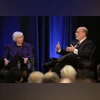 "Bernanke, Yellen urge US Supreme Court to overturn Trump's tariffs")


