Chandrayaan-3 data confirms Moon's surface was once an ocean of magma

Latest Chandrayaan-3 data, as reported by Isro, has confirmed the theory that states that the lunar surface was once covered by an ocean of magma
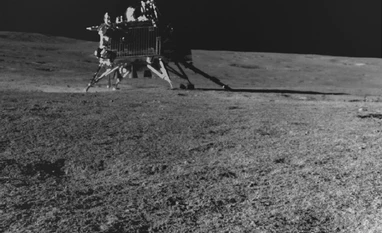
Chandrayaan-3 Lander, ISRO
Vikram Lander (Photo: Twitter/@isro)
Sudeep Singh Rawat New Delhi
3 min read Last Updated : Aug 22 2024 | 6:11 PM IST

Don't want to miss the best from Business Standard?

It's been a year since India launched the historic moon mission, Chandrayaan-3, to the southern pole of the moon, making the country the first to land a rover in the region.

The Chandrayaan-3 has been sharing crucial data with the Isro scientists to shed light on the less explored lunar surface. 

Recently, a team of scientists, using data from Chandrayaan-3, shared evidence that a vast magma may once have existed on the South Pole that has been covered in mystery. The researchers published their findings in the journal Nature on Wednesday. 

The new discovery from Chandrayaan-3 findings reveals that a sea of hot, molten rock or magma once existed under the lunar surface. These latest findings open up new areas to study the surface while potentially identifying safe landing spots. 

The recent theory emphasises that there might be a large amount of Magma that cooled to form the surface of the moon around 4.2 billion years ago.

The Physical Research Laboratory (PRL), Ahmedabad, has shared the data obtained from the third moon mission after a year of the historic Chandrayaan-3 mission.

The Chandrayaan 3 lander-rover has gone to where no craft had explored before and shared the very first samples of the moon's southern polar region.

The findings share evidence through chemical remnants in the rocks of the former ocean of magma, adding to other proof presented in the northern hemisphere sample from the moon. It also has a similar composition in terms of minerals and other chemical make-up despite geographical distance. 

The Pragrayn rover has travelled 103 meters on the lunar surface and made 23 on-spot or in-situ analyses at various locations to study the lunar soil (regolith) composition. 

The study also revealed that a mixture of magnesium and olivine compounds existed typically within the moon at a depth of around 100 kilometres. The team of scientists believes that these materials came from a large impact crater of 2500-km wide, in the South Pole. 

Neeraj Srivastava, the co-author and lunar geologist, explained, “The sample we analysed was very unique for its composition. It had material from the surface, from below the surface, and from deep within the Moon.”

“The geological context of this area makes it a special case, as it also contains material mixed in from the large crater in the South Pole Aitken (SPA) basin,” he added.

What are magma oceans?

According to the National Aeronautics and Space Administration (Nasa), magma oceans cover the surface of a celestial body when the formation of a terrestrial planet and some lunar formation takes place. 

Scientists believe that the moon was formed when two protoplanets or developing planets collided. Resultantly, the smaller protoplanet, known as Moon, came into existence which was so hot that its entire mantle was molten magma or a magma ocean. 

If this theory is true, then the magma ocean would have existed from the time of formation of the moon which is about 4.5 billion years to no more than tens of millions of years later.

*Subscribe to Business Standard digital and get complimentary access to The New York Times

Smart Quarterly

₹900

3 Months

₹300/Month

SAVE 25%

Smart Essential

₹2,700

1 Year

₹225/Month

SAVE 46%
*Complimentary New York Times access for the 2nd year will be given after 12 months

Super Saver

₹3,900

2 Years

₹162/Month

Subscribe

Renews automatically, cancel anytime

Here’s what’s included in our digital subscription plans

Exclusive premium stories online

  • Over 30 premium stories daily, handpicked by our editors

Complimentary Access to The New York Times

  • News, Games, Cooking, Audio, Wirecutter & The Athletic

Business Standard Epaper

  • Digital replica of our daily newspaper — with options to read, save, and share

Curated Newsletters

  • Insights on markets, finance, politics, tech, and more delivered to your inbox

Market Analysis & Investment Insights

  • In-depth market analysis & insights with access to The Smart Investor

Archives

  • Repository of articles and publications dating back to 1997

Ad-free Reading

  • Uninterrupted reading experience with no advertisements

Seamless Access Across All Devices

  • Access Business Standard across devices — mobile, tablet, or PC, via web or app

More From This Section

Topics :ISROChandrayaan-3moon missionScientists

First Published: Aug 22 2024 | 6:11 PM IST

Next Story