Home / World News / World's first solar-thermal power plant commences in China's Gobi Desert
World's first solar-thermal power plant commences in China's Gobi Desert
The thermal power station, built by the China Three Gorges Corporation, is located in Guazhou County and utilises two towers to feed a single turbine system, marking a first for the plant
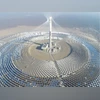
The Chinese solar thermal plant is part of a broader clean-energy hub. Image: Wikimedia Commons
4 min read Last Updated : Oct 09 2025 | 1:13 PM IST
In a first, China has switched on a solar thermal power station in the Gobi Desert, a project described as a more cost-effective and efficient use of the technology, with the potential to be scaled up, South China Morning Post reported.
The thermal power station built by the China Three Gorges Corporation, the plant in Guazhou County, uses two towers to feed a single turbine system.
Approximately 27,000 mirrors have been installed to concentrate sunlight onto two 200-meter-high towers positioned roughly one kilometre apart. The process produces concentrated heat that melts and stores it at temperatures of up to 570 degrees Celsius (1,058 degrees Fahrenheit). The stored heat, in turn, is used to produce steam that drives the turbines, allowing power generation to continue after sunset or during cloudy weather, the report added.
The report, citing state broadcaster CCTV, said that the dual-tower setup allows the east tower to capture sunlight in the morning, while the west tower collects it in the afternoon. This allows the tower setup to be 25 per cent more effective as compared to a single-tower design.
With the two mirror fields overlapping partly, the plant requires fewer mirrors, which is significant in cost savings as the mirrors make up the bulk of the construction expense.
CCTV reported that the dual-tower design and the possibility of future multi-tower systems overcome the capacity constraints of single-tower plants and pave the way for expanding solar thermal power generation in China.
The Chinese solar thermal plant is part of a broader clean-energy hub, as compared to the many earlier solar thermal projects of Europe and the United States, which operated as stand-alone plants. Together with extensive solar and wind farms in the region, the Chinese plant is projected to provide electricity to around half a million households annually.
The one advantage that solar thermal power offers over traditional solar panels is its ability to generate electricity even after sunset. The technology saw rapid growth in Spain and the United States more than a decade ago, owing to the generous government subsidies. However, it declined eventually as the cost of photovoltaic (PV) panels fell sharply, by more than 80 per cent, leaving many solar thermal projects struggling financially or facing bankruptcy.
China's approach, on the other hand, evolved differently. It first focused on building an extensive low-cost PV and wind energy capacity, specifically across its sunny and windy western provinces, including Gansu, Xinjiang, and Qinghai. This, in turn, posed a new challenge, since these energy sources were considered intermittent and could not meet demand during nights or periods of low sunlight and wind. Solar thermal power then emerged as a complementary technology and not a rival to PV, one that can bridge the gaps, the report added, citing Wang Zhifeng, a senior researcher at the Chinese Academy of Sciences.
Wang noted that nearly 60 per cent of the solar thermal plant's cost comes from its mirror systems, which must be precisely curved, highly polished, and capable of tracking the sun with great accuracy.
The CCTV report also added that China has already built 21 commercial solar thermal power plants with a combined capacity of 1.57 million kilowatts. An additional 30 projects under construction are expected to add another 3.1 million kilowatts of capacity.
Globally, the 700-megawatt Noor Energy 1 project in the United Arab Emirates is currently the largest operating solar thermal complex. China has also played a role in developing other major projects, including Morocco’s Noor complex and Chile’s Cerro Dominador, where solar thermal power remains an integral part of national clean energy strategies.


 "World's first solar-thermal power plant commences in China's Gobi Desert")

