US President Donald Trump on Wednesday renewed his push for the United States to acquire Greenland, telling global leaders at the World Economic Forum in Davos that the Arctic island is part of North America and cannot be secured by any country other than the US.
“Greenland is a part of North America, that’s our territory,” Trump said as he argued that the island’s strategic location makes American control essential for international security.
“No other nation is going to be able to take care of Greenland than the US. We are a much greater power,” he added, as European leaders looked on. He further said that he won't use force to acquire Greenland.
‘We saved Greenland’: Trump’s security argument
Trump justified his position by invoking history and geopolitics, claiming the US had already played a decisive role in Greenland’s fate during the Second World War.
“Denmark knows that. We fought for Denmark during World War II, we saved Greenland,” he said. “After the war, which we won, we gave Greenland to Denmark. How stupid were we to do that? But we did.”
Describing Greenland as “vast and almost uninhabited”, Trump said the territory sits “undefended in a key strategic location between the US, Russia and China”.
“We don’t need Greenland for rare earths,” he said, adding, “There is no such thing as rare earth, there is rare processing. We need Greenland for international security.”
‘This will not hurt NATO’
Seeking to ease alliance concerns, Trump said US control of Greenland would not undermine NATO.
“This would not hamper NATO,” he said. “I have helped NATO more than any other president.”
Reiterating his core argument, Trump added: “Every nation has an obligation to defend itself. No country can secure Greenland other than the United States.”
He said he had “tremendous respect” for the people of Greenland and Denmark, but insisted strategic realities left no alternative.
The US President further said that his country paid NATO when no one else was paying. "We will be there for NATO, but I am not sure if they would be there for us," he added.
Europe ‘not heading in the right direction’
Trump used his Davos address to criticise Europe’s economic and energy policies, urging leaders to follow the US model.
“I love Europe, and I want to see Europe do well, but it’s not heading in the right direction,” he said, blaming rising government spending, migration policies and trade decisions for leaving parts of the continent “unrecognisable”.
He said Europe must “do what we’re doing” economically, arguing that American growth drives global prosperity.
“The US is the economic engine of the world,” Trump said. “When America booms, the entire world booms. When it goes bad, you all follow us down.”
Energy, AI and ‘the biggest hoax’
Trump sharply attacked renewable energy policies, calling the Green New Deal “the biggest hoax”.
“Windmills are destroying land and losing money,” he said, claiming Germany produces 22 per cent less electricity than it did in 2017. He added that China manufactures wind turbines “to sell to stupid people” while relying mainly on coal.
The US president said his administration approved multiple new nuclear reactors and allowed large companies to build their own power plants, citing improved safety standards.
“We are leading China by a lot in AI,” Trump said, arguing that strong domestic energy production is critical for technological leadership.
‘We want Europe to be strong’
Trump, however, said US interests remain aligned with Europe’s stability.
“I care greatly for the people of Europe,” he said, referencing his Scottish and German ancestry. “We want Europe to be strong, it matters for national security.”
He singled out the UK’s energy struggles, claiming electricity prices had surged while drilling in the North Sea remained restricted.
“There are windmills all over Europe, and they are losers,” Trump said. “China makes them, but you don’t see wind farms there.”
Trump’s remarks came as US and European Union trade representatives met on the sidelines of Davos. EU trade chief Maroš Šefčovič said he discussed ways to avoid a “downward spiral” in trade and stressed that the bloc favours dialogue and predictability for transatlantic business.
However, Trump’s comments on Greenland and Europe’s economic direction underscored widening differences between Washington and its allies on security, energy and global leadership.

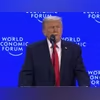 "US won't use force to acquire Greenland, but will 'remember' a no: Trump")


