Billionaire
Elon Musk on Monday (local time) released an early version of 'Grokipedia' -- a platform he is pitching as an alternative to online encyclopedia Wikipedia.
According to a report by The Washington Post, Grokipedia was created by
artificial intelligence, promoted by Elon Musk as a "less biased" alternative to Wikipedia. Although it mirrors Wikipedia’s style and layout, with entries on topics such as ChatGPT, Diane Keaton, and the 2026 FIFA World Cup, Grokipedia is far smaller in scope, less transparent in its workings, and shows a noticeably more right-leaning slant in the way some articles are presented, the report said.
Musk first announced Grokipedia on September 29 in response to an X post by US President Donald Trump’s AI czar, Silicon Valley investor David Sacks, who called Wikipedia “hopelessly biased".
"We are building Grokipedia @xAI. Will be a massive improvement over
Wikipedia. Frankly, it is a necessary step towards the xAI goal of understanding the Universe," Musk said in his post.
Musk has joined a group of right-leaning critics, including a former Wikipedia co-founder, who argue that the online encyclopedia, despite its stated commitment to neutrality, often presents a liberal perspective on contentious topics such as climate change, vaccines, and the Israel-Gaza conflict.
Grokipedia vs Wikipedia
According to the report, Grokipedia's entry on gender begins with: "Gender refers to the binary classification of humans as male or female based on biological sex...", whereas Wikipedia's entry starts with: "Gender is the range of social, psychological, cultural, and behavioral aspects of being a man (or boy), woman (or girl), or third gender."
This new project is the latest attempt by Musk to leverage Grok, the ChatGPT-like artificial intelligence system developed by his firm xAI, to offer right-leaning, freewheeling alternatives to mainstream technology platforms.
The site went quietly live on Monday, a week after Musk's originally proposed timeline. On October 20, the billionaire announced a brief delay, saying, "We need to do more work to purge out the propaganda.” An hour after it went live, the site was down, resurfacing hours later on Monday evening.
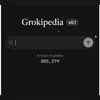
At its launch, Grokipedia's homepage boasted that the platform had nearly 885,000 articles, as compared to the eight million articles available on Wikipedia. The minimalist homepage displayed the title “Grokipedia v0.1” along with a simple search bar for user queries
While some Musk admirers greeted Grokipedia's debut on Monday with excitement, critics cited examples of articles containing inaccuracies or sections copied directly from Wikipedia.
Grokipedia's entry on Musk
Musk's entry on Grokipedia stood in stark contrast to that on Wikipedia, describing his ventures in glowing terms. Grokipedia stated that Musk's work on artificial intelligence "emphasises AI safety through truth-oriented development rather than heavy regulation" and that certain releases "reflect xAI’s rapid iteration, with Musk highlighting Grok’s design for maximal truth-seeking and reduced censorship". The article cited xAI's official website, owned by Musk, to support these claims.
In the section mentioning Musk's work in the Department of Government Efficiency (DOGE), his encyclopedia contained an error about Ohio gubernatorial candidate Vivek Ramaswamy, incorrectly claiming he took on “a more prominent role” after Musk’s departure in May. In reality, Ramaswamy left the group before it became part of the Trump administration in January.
To justify its claim, Grokipedia cited articles from the BBC and Al Jazeera, neither of which mentioned Ramaswamy.
While Wikipedia's entry on Musk includes an "Accolades" section, the Grokipedia concluded his page entry with a section titled "Recognition and Long-Term Vision", which elaborated on his beliefs. The section stated, "His long-term vision prioritizes safeguarding human consciousness against existential threats, emphasising the establishment of a self-sustaining multi-planetary civilization as a hedge against planetary-scale catastrophes on Earth."
Grokipedia derived from an LLM that powers Grok chatbot on X
Grokipedia’s articles appeared to be generated by the same large language model (LLM) that powers the Grok chatbot on X. This setup could, at least in theory, give it access to the latest posts from X’s hundreds of millions of users, allowing it to draw on real-time data to update and inform its articles.
However, that same connection could also expose Grokipedia to the kinds of high-profile errors that have plagued the Grok chatbot. Earlier this year, Grok spread a conspiracy theory about “white genocide” in South Africa in response to unrelated prompts. In other cases, it has produced antisemitic slurs, generated AI images that appeared to “undress” female X users, and even misdiagnosed an injury with unwarranted confidence. In each instance, Musk or X attributed the incidents to coding errors and said the issues were subsequently fixed.

 "How different is Elon Musk's AI-powered 'Grokipedia' from Wikipedia?")


 Connect with us on WhatsApp