US President
Donald Trump has withdrawn his threat to withhold aid to Jordan after King Abdullah II agreed to take in 2,000 critically ill children from Gaza. The development comes after the two leaders met at the White House.
Trump also reiterated his vision for US involvement in Gaza’s future, but King Abdullah II avoided direct comment on the proposal. Instead, he said that discussions on the territory's future would take place at an upcoming Saudi Arabia meeting, pending Egypt’s proposal.
During the meeting, Trump praised the Jordanian leader’s commitment to accepting sick children, calling it a “beautiful” act. “We contribute a lot of money to Jordan and to Egypt, by the way, a lot to both. But I don’t have to threaten that. I think we’re above that,” Trump told reporters.
At the start of the meeting, Abdullah assured that the children, many suffering from cancer or in critical condition, would be transferred to Jordan “as quickly as possible”.
Trump's Gaza plan
Trump’s controversial suggestion to transform Gaza into a US-owned “Riviera” has sparked widespread condemnation across the West Asia, raising concerns about regional stability. Arab leaders, including Abdullah, have had to engage with the US President despite their reservations.
Jordan had been expected to convey a unified Arab opposition to Trump’s plan, which critics have likened to forced displacement. Both Jordan and Egypt have already rejected proposals to relocate Gaza’s Palestinian population, with Trump previously referring to the violence-torn region as a “demolition site”.
Despite opposition, Trump has remained resolute. In a recent Fox News interview, he stated that Palestinians leaving Gaza would not have the right to return and hinted at using US foreign aid as leverage. “I’m talking about building a permanent place for them” because Gaza is “not habitable,” he said.
Gaza crisis: US' aid leverage
Ahead of Abdullah’s visit, Trump had escalated pressure, suggesting he might withhold aid from Jordan and Egypt if they refused to accept Palestinian refugees. “Yeah, maybe, sure why not? If they don’t, I would conceivably withhold aid, yes,” he told reporters.
However, he later walked back this stance, clarifying that he had no intention of personally investing in Gaza. “No,” he said, “you could just do more good for people when you’re President.”
Jordan and Egypt remain key US allies and among the largest recipients of American aid, with Jordan particularly reliant, as US assistance accounts for 3 per cent of its GDP.
Uncertainty in West Asia
Concerns over regional stability persist, with Arab nations wary of broader unrest. The conflict in Gaza, Israeli strikes in Lebanon, Syria’s ongoing turmoil, and internal security challenges in Jordan and Egypt compound the uncertainty. Additionally, Saudi Arabia is reassessing its stance on potential normalisation with Israel.
Trump’s stance has added further unpredictability, particularly as Hamas delays the next release of Israeli hostages. He has warned that all remaining hostages must be freed by Saturday or “all bets are off, and let hell break out.”
Israeli Prime Minister Benjamin Netanyahu reinforced this position, stating that if Hamas fails to comply by the deadline, the ceasefire will end and military action will resume. However, it remains unclear whether Netanyahu was referring to all hostages or only those in the next planned exchange.
Trump’s vision for Gaza’s future
In his interview with Fox News, Trump reiterated his view that Palestinians leaving Gaza should not return and suggested Jordan and Egypt as relocation sites. He has framed this as a step toward Middle East peace, proposing investment in hotels and infrastructure in Gaza.
Seated alongside Trump during his White House remarks were key officials, including Secretary of State Marco Rubio, Chief of Staff Susie Wiles, and National Security Adviser Mike Waltz.
Describing Gaza as a “death trap,” Trump insisted that many Palestinians would willingly leave if given an alternative. “They would love to get out of Gaza, but until now, they’ve never had an alternative. Now they have an alternative,” he said.
While a ceasefire currently holds, uncertainty looms over its longevity, as Hamas delays hostage releases and Israel signals its readiness to resume military action if conditions are not met.

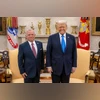 "Jordan agrees to take in Palestinian children after Trump's US aid threat")


