
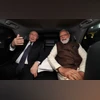
Putin-PM Modi car selfie speaks 'thousand words': US representative
The United States had earlier imposed 50 per cent tariffs on most Indian goods in August 2025 amid broader trade disputes and concerns over India's purchases of Russian oil
 "Putin-PM Modi car selfie speaks 'thousand words': US representative")
WebinarsNew
Deep DiveNew
Explore Business Standard
The United States had earlier imposed 50 per cent tariffs on most Indian goods in August 2025 amid broader trade disputes and concerns over India's purchases of Russian oil
US representative Sydney Kamlager-Dove while talking about the famous car selfie of Prime Minister Narendra Modi with Russian President Vladimir Putin said that it spoke a thousand words.
Dove said that US President Donald Trump's coercive policies come with a cost.
"Trump's policies towards India can only be described as cutting our nose to spite our face... Being a coercive partner has a cost. And this poster is worth a thousand words. You do not get a Nobel Peace Prize by driving US strategic partners into the arms of our adversaries. We must move with incredible urgency to mitigate the damage that this administration has done to the US-India partnership and return to the cooperation that is essential to US prosperity, security, and global leadership," she said.
These remarks were made at The House Foreign Affairs South and Central Asia Subcommittee's hearing titled, 'The US-India Strategic Partnership: Securing a Free and Open Indo-Pacific'.
Talking in the same platform, US Representative Pramila Jayapal raised concerns over trade barriers and immigration policies affecting India-US economic and people-to-people ties.
Jayapal pointed to ongoing tariff challenges impacting both countries, stressing their consequences for businesses and consumers. She said, "We also are facing challenges around tariffs, both here in the United States and in India. These tariffs are damaging India's economy and also hurting American businesses and consumers."
Her concerns over tariffs came as trade tensions escalated further following comments by US President Donald Trump on Tuesday. Trump warned of possible new tariffs on India's rice exports, accusing New Delhi of "dumping" cheap rice into the American market and harming US farmers. His remarks were made during a White House meeting where he also announced a USD 12 billion aid package for American agricultural producers.
During the meeting, several US farmers complained that low-cost imports from India, Vietnam and Thailand were driving down domestic prices. Responding to these concerns, Trump questioned why additional duties had not been imposed on India and said he would "take care" of the alleged dumping, signalling that fresh tariffs could soon be considered.
These developments came as a US trade delegation was already in India on December 10-11 for negotiations that have struggled to yield substantial progress. The ongoing talks have been weighed down by disagreements over market access and tariff measures, deepening strain in the trade relationship.
The United States had earlier imposed 50 per cent tariffs on most Indian goods in August 2025 amid broader trade disputes and concerns over India's purchases of Russian oil. Trump's latest warning has added fresh uncertainty to already difficult negotiations, heightening the risk of further trade friction between the two countries.
(Only the headline and picture of this report may have been reworked by the Business Standard staff; the rest of the content is auto-generated from a syndicated feed.)
First Published: Dec 11 2025 | 9:20 AM IST


 Connect with us on WhatsApp