Home / World News / S Korea's Yoon defends martial law in first public appearance since arrest
S Korea's Yoon defends martial law in first public appearance since arrest
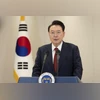
Yoon Suk Yeol's presence at the court was his first public appearance since becoming South Korea's first sitting president to be detained over his short-lived declaration of martial law
Yoon, a conservative, has since argued that his dispatch of troops was not meant to block the assembly but instead was a warning to the main liberal opposition Democratic Party. | File Photo: PTI
South Korea's impeached president denied Tuesday that he ordered the military to drag lawmakers out of the National Assembly to prevent them from voting to reject his martial law decree last month, as he appeared for the first time before the Constitutional Court that will determine his fate.
Yoon Suk Yeol's presence at the court was his first public appearance since becoming South Korea's first sitting president to be detained over his short-lived declaration of martial law, which plunged the country into political turmoil.
After abruptly imposing martial law on Dec 3, Yoon sent troops and police officers to encircle the National Assembly, but enough lawmakers managed to enter to vote unanimously to reject his decree, forcing Yoon's Cabinet to lift the measure early the following morning.
Yoon, a conservative, has since argued that his dispatch of troops was not meant to block the assembly but instead was a warning to the main liberal opposition Democratic Party, which has used its legislature majority to obstruct Yoon's agenda, undermine his budget bill and impeach some of his top officials. In his announcement of martial law, Yoon called the assembly a den of criminals that was bogging down government affairs, and vowed to eliminate shameless North Korea followers and anti-state forces.
The commanders of military units sent to the assembly have disagreed with Yoon's stance. Kwak Jong-keun, commander of a special forces unit, told an assembly hearing that Yoon had called him directly and asked that his troops quickly destroy the door and drag out the lawmakers who are inside. Kwak said he didn't carry out the order.
Asked by acting Constitutional Court chief justice Moon Hyungbae whether he ordered the commanders to pull out the lawmakers, Yoon replied that he didn't do so.
Yoon said the lawmakers could have gathered somewhere later to overturn the decree. He also argued that there would have been a popular backlash if he had tried to physically prevent an assembly vote.
If I had obstructed (the vote), I think I wouldn't have been able to handle the consequences, Yoon said.
Asked by Moon about reports that he gave a memo on establishing an emergency legislative body to a top official before imposing martial law, Yoon said he didn't do so. Whether Yoon plotted to launch such a body would help explain his true intentions for martial law.
The assembly impeached Yoon on Dec 14, suspending his presidential powers. The Constitutional Court has until June to determine whether to formally dismiss him as president or reinstate him. Observers say a court ruling is expected to come sooner.
Separately, law enforcement authorities are investigating whether Yoon and others committed rebellion, abuse of power and other crimes in connection with the martial law decree. By law, the leader of a rebellion can face life in prison or the death penalty.
Yoon earlier ignored several requests to appear for questioning and remained in his presidential residence in Seoul, though his defence minister, police chief and several top military commanders had already been arrested over their roles in the enforcement of martial law. He was eventually detained on Jan 15 when authorities mobilised hundreds of police and investigators near his residence.
While South Korean presidents have wide-ranging immunity from prosecution while in office, the protection does not extend to allegations of rebellion or treason.
Yoon's martial law decree has rattled South Korea's diplomatic activities and financial markets and hurt its international image as a vibrant democracy. Yoon's subsequent defiance and the opposition's push to oust him have also intensified South Korea's already-serious internal divide.
After a Seoul district court on Sunday approved a formal arrest warrant to extend Yoon's detainment, dozens of his supporters stormed the court building, destroying windows, doors and other property. They also attacked police officers with bricks, steel pipes and other objects. The violence left 17 police officers injured, and police said they detained 46 protesters.
(Only the headline and picture of this report may have been reworked by the Business Standard staff; the rest of the content is auto-generated from a syndicated feed.)

 "S Korea's Yoon defends martial law in first public appearance since arrest")


