
Summers in Arctic were ice-free over 100,000 years ago, finds research
To gain a deeper understanding of the climate dynamics in a world without the Arctic sea ice, researchers have turned to analogues from our geological past
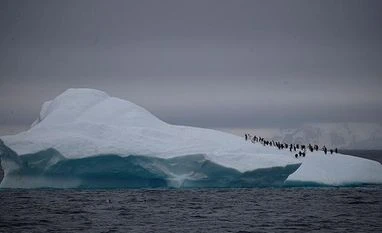 "Summers in Arctic were ice-free over 100,000 years ago, finds research")
Explore Business Standard
To gain a deeper understanding of the climate dynamics in a world without the Arctic sea ice, researchers have turned to analogues from our geological past
A subpolar plankton species found in the Atlantic water expanded far into the Arctic Ocean during the Last Interglacial, indicating that summers in the Arctic were ice-free during this period.
Published in Nature Geoscience, this research analysed the microfossil content of sediment cores to determine the extent of sea ice present during the Last Interglacial, a recent period of the Earth's geological history characterised by a climate warmer than today.
The Arctic sea ice, an important component of the Earth system, is disappearing fast due to climate warming, whereas the summer sea ice is anticipated to vanish entirely within this century.
To gain a deeper understanding of the climate dynamics in a world without the Arctic sea ice, researchers have turned to analogues from our geological past.
However, the extent of sea ice during this period has been intensely debated and there is no consensus, limiting understanding of this period and the ability of researchers to simulate it in climate models.
To address this, a team of marine geology researchers from the Department of Marine Geological Sciences at Stockholm University analysed the microfossil content of an array of sediment cores from sites that today lie directly beneath the thickest parts of the modern Arctic ice pack.
In these cores, they investigated the variability in the occurrence and composition of planktonic foraminifera, a type of free-floating, shell-building unicellular zooplankton that is sensitive to changes in oceanographic and environmental conditions.
The Last Interglacial, between 129,000 and 115,000 years BP, is an interesting period to study because it is the last time in Earth's history when global average temperatures were similar or perhaps higher than currently and sea levels were considerably higher, up to +6 to +9 m, said Flor Vermassen, a postdoctoral researcher at Stockholm University and an author of the research paper.
During their study, the researchers found high abundances of the typically subpolar Atlantic water species Turborotalita quinqueloba, indicating a large-scale expansion of the species far into the central Arctic Ocean.
The ecological preference of T. quinqueloba for predominantly ice-free, seasonally productive waters typically present in the Atlantic Ocean suggests that it was following similar conditions that had spread to the central Arctic Ocean.
The absence of summer sea ice and the increased influence of Atlantic currents in the Arctic domain during the Last Interglacial are analogous to ocean transformations being observed today in parts of the Arctic, and collectively referred to as Atlantification' of the Arctic Ocean.
The finding that the Arctic Ocean was seasonally ice-free during the Last Interglacial is worrying because this period would have been only around 1.5C above our pre-industrial levels, comparable to the targets of the Paris Agreement. Yet the global sea level is estimated to have been several meters higher than at present, Vermassen said.
Therefore, the researchers proposed the Last Interglacial as the most recent and potentially the most relevant geological epoch for investigating a seasonally ice-free Arctic Ocean, particularly if the objectives of the Paris Agreement are not exceeded.
Vermassen added, "To fully comprehend the physical conditions and environment of this unfamiliar Arctic during the Last Interglacial, additional quantitative proxy reconstructions of sea-surface temperature and other water mass parameters are needed, along with targeted climate and oceanographic model studies of the same period.
(Only the headline and picture of this report may have been reworked by the Business Standard staff; the rest of the content is auto-generated from a syndicated feed.)
First Published: Aug 05 2023 | 7:25 PM IST


