
Trump's reversal of policy on Ukraine raises questions about Taiwan support
Trump was quite popular in Taiwan when he left office in 2021 and was widely credited with bringing the US and the democratically governed island closer together
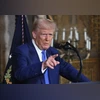 "Trump's reversal of policy on Ukraine raises questions about Taiwan support")
Explore Business Standard
Trump was quite popular in Taiwan when he left office in 2021 and was widely credited with bringing the US and the democratically governed island closer together
US President Donald Trump's abrupt reversal of three years of American policy toward Ukraine has raised concerns China might become emboldened to push its territorial claim on Taiwan, though experts say Beijing is most likely in a wait-and-see mode right now to see how the situation in Europe plays out. ALSO READ: Taiwan records 8 Chinese aircraft, 7 vessels, 2 ships near its territory
In the past two weeks, Trump has falsely claimed Ukraine should have never started the war, said Ukraine may be Russian someday and questioned the legitimacy of President Volodmyr Zelenskyy's government, while upending the longstanding American position of isolating Russia over its aggression by beginning direct talks with Moscow and voicing positions sounding remarkably like the Kremlin's own.
Before heading to Washington for talks with Trump on Monday, French President Emmanuel Macron said he would emphasize you can't be weak in the face of President Putin.
It's not you, it's not your trademark, it's not in your interest, Macron said he would tell Trump. How can you, then, be credible in the face of China if you're weak in the face of Putin? What does Ukraine have to do with Taiwan? Like Moscow's claim Ukraine is rightfully Russian territory, China claims the self-governing island of Taiwan as its own. Chinese President Xi Jinping has not ruled out taking it by force.
Trump on Friday appeared to walk back his earlier comments inaccurately blaming Ukraine for starting the war, but his administration's overall abrupt shift in policy on the conflict could cause some in Taiwan to question whether the United States could pull the rug out from underneath them as well, said Russell Hsiao, executive director of the Global Taiwan Institute in Washington.
Still, while Beijing is certainly paying close attention to Trump's comments, it is unlikely to act in haste, he said.
I don't think Xi Jinping will be so brash as to roll the iron die on the conclusion that just because Trump acted in a certain way concerning Ukraine he would do the same over Taiwan, Hsiao said. Trump is too unpredictable.
Trump administration has shifting positions on Taiwan Trump was quite popular in Taiwan when he left office in 2021 and was widely credited with bringing the US and the democratically governed island closer together.
By American law, the US is obligated to supply Taiwan with sufficient hardware and technology to fend off invasion from the mainland, but maintains a policy of strategic ambiguity on whether it would come to Taiwan's defense.
Recently, Trump has been more critical of Taiwan, saying it should pay the US for its military defence. On several occasions, he also has accused Taiwan of taking computer chip manufacturing business away from the US and suggested earlier this month he might impose tariffs on semiconductors.
At the same time, Trump has appointed many China hawks in his administration, including in top-level positions such as Secretary of State Marco Rubio and Defense Secretary Pete Hegseth.
After meeting Nato allies in Brussels earlier this month, Hegseth stressed that if the US were to pull back support from Ukraine, it would be to concentrate on the Asia-Pacific region and leave European defense primarily to Europeans.
The deterrent effect in the Pacific is one that really can only be led by the United States, Hegseth said.
A few days later, Rubio issued a joint statement with his counterparts from Japan and South Korea after they met on the sidelines of a security conference in Munich, stressing the importance of maintaining peace and stability across the Taiwan Strait as an indispensable element of security and prosperity for the international community.
In a move that irked Beijing, the State Department also removed a line on American opposition to independence for Taiwan in a revised US government fact sheet on the island.
Comments seem likely to give Beijing pause If I were Beijing, I would be paying the most attention to what Hegseth said about why the US is changing its support to Ukraine, said Meia Nouwens, senior fellow for Chinese security and defense policy at the International Institute for Strategic Studies in London.
Hegseth said this is about the Indo-Pacific, that the US has priorities elsewhere, and I don't think, from Beijing's perspective, that would have been comforting," Nouwens said.
The shift on Ukraine will give China the opportunity to push a message that the US is an unreliable partner, she said, but it was unlikely Beijing would read Washington's seeming willingness to concede Ukrainian territory as it being somehow open to Taiwan falling into Chinese hands.
The broader trend lines of each country, of the US and China, looking forward aren't necessarily changing, Nouwens said. Neither wants to give up any space, both want to continue on a trajectory that increases their national strength.
It is worth noting that in the early months of Trump's first term, there were concerns his administration might be moving too close to China, but he actually took a much tougher approach than some before him, said Euan Graham, a senior defense analyst with the Australian Strategic Policy Institute.
Graham said that while all American allies should be concerned by the Trump administration's abandonment of Ukraine and willingness to deal with Putin," it would be simplistic" to assume a similar arrangement would apply to the China-Taiwan situation.
It's more likely that the US administration is attempting, misguidedly, to get Ukraine out of the way by making it a European problem, in order to face China from a relatively stronger position, Graham said. I think it's a dangerous approach, because of the appalling precedent it sets. But it's unlikely to be repeated with China.
(Only the headline and picture of this report may have been reworked by the Business Standard staff; the rest of the content is auto-generated from a syndicated feed.)
First Published: Feb 24 2025 | 4:48 PM IST


