“Nothing’s going to happen until Putin and I get together,” Trump told reporters aboard Air Force One en route to the United Arab Emirates. “And obviously he (Putin) wasn’t going to go (to Turkey). He was going to go, but he thought I was going to go. He wasn’t going if I wasn’t there.”
'Low-level' Russian delegation fuels frustration
Trump said he never expected Putin to attend the Istanbul peace summit. On Wednesday night (May 14), Putin appointed a lower-level delegation led by his aide Vladimir Medinsky, who had previously led Russia’s delegation in Istanbul during failed peace efforts in early 2022, to represent Moscow at the talks. There was no indication that Putin intended to participate personally.
Putin’s appointed delegation also includes Deputy Foreign Minister Mikhail Galuzin, Deputy Defence Minister Alexander Fomin, and military intelligence chief Igor Kostyukov, alongside four unnamed “experts”.
Ukrainian President
Volodymyr Zelenskyy, upon arriving in Ankara, criticised the delegation, calling it “a sham”. He added that further decisions would follow his discussions with Turkish President Recep Tayyip Erdogan.
At a Nato foreign ministers’ meeting in Antalya, European diplomats condemned Putin for undermining peace efforts. Polish Foreign Minister Radoslaw Sikorski stated, “We hope that the President of the United States sees this mockery for what it is and draws the right conclusions.”
Expectations had been high for a direct meeting between Zelenskyy and Putin — something that has not occurred since the conflict began over three years ago. Putin had recently called for a resumption of direct dialogue during a late-night address on Saturday.
Push for ceasefire and stronger sanctions
Ukraine and several European countries had called for an immediate 30-day ceasefire starting May 12. The US reportedly backed these demands and was prepared to impose additional sanctions on Russia if Putin failed to comply.
Although Russian envoys reached Istanbul, Ukraine insisted that talks must be held between national leaders, not lower-level officials, according to a source familiar with the discussions, news agency Reuters reported.
During a stop in Qatar, Trump said he had considered travelling to Turkey. “I was thinking about going, but it’s very tough because of what we’re doing today and tomorrow,” he said. “But you know, if something happened, I’d go on Friday if it was appropriate.”
Meanwhile, US Secretary of State Marco Rubio, who is also in Antalya, reaffirmed America’s commitment to peace. He is expected to join Trump envoys Steve Witkoff and Keith Kellogg in Istanbul on Friday.
US ceasefire proposal rejected by Moscow
Russia has rejected a US ceasefire plan that would freeze the conflict along existing frontlines, recognise Crimea as Russian territory, and lead to the lifting of US sanctions. In exchange, Ukraine would gain security assurances and the right to strengthen its military.
Washington later expanded the proposal to include a revival of the Nato-Russia Council, which had collapsed following Russia’s 2022 invasion.
As talks in Istanbul face uncertainty, the Nato ministerial meeting in Antalya aimed to align transatlantic positions. European officials urged Trump to uphold sanctions if Russia continues its military aggression or refuses meaningful engagement with Zelenskyy.
Though European leaders announced that Washington supported the May 12 ceasefire deadline, Trump has not publicly endorsed it.
Nato Secretary General Mark Rutte expressed cautious optimism, saying a breakthrough could happen if "...the Russians are willing to play ball”.
Sanctions divide US and Europe
Discussions between US and European officials earlier this week also revealed divisions between the two sides. According to a Bloomberg report, the American side appeared hesitant to impose sanctions should Russia ignore the ceasefire or refuse to meet with Zelenskyy.
European nations are now expected to pressure Trump to follow through with penalties if no progress occurs in the coming days.
Bipartisan push for economic measures in US
Earlier, Ukrainian Foreign Minister Andrii Sybiha met with Rubio and US Senator Lindsey Graham in Antalya to discuss peace prospects. Graham, a key Trump ally, said there was bipartisan support in Congress for a sanctions bill that would impose “bone-crushing” economic measures against Russia.
The bill includes a proposed 500 per cent tariff on imports from countries buying Russian energy or uranium.
Besides, French Foreign Minister Jean-Noel Barrot said he would meet Graham to discuss coordination between European and US sanctions. “We want to build upon, to add European deterrence sanctions to this US package,” he said. New measures would target oil and financial institutions.
The European Union, meanwhile, has agreed on its 17th sanctions package, aimed at disrupting Russia’s shadow oil fleet and penalising those who help Moscow circumvent energy restrictions. However, the measures were considered incremental.
Trump warns Moscow as Kremlin digs in
Trump has called for dialogue between the two sides and hinted at further sanctions if Moscow continues to stall. Nevertheless, Putin maintains that Western military aid to Ukraine must be halted before any serious negotiations can happen.
Russia claims sanctions will not alter its stance and says it has adapted to restrictions since the war began. In Moscow, Russian diplomat Rodion Miroshnik said on Thursday that a ceasefire would only be viable if part of a broader strategy to resolve the conflict. His comments indicated continued Kremlin resistance to immediate de-escalation without meeting its key objectives.

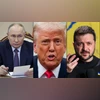 "Nothing will happen until I meet Putin: Trump on Russia-Ukraine peace talks")


