


Tell My Mother I Like Boys: Suvir Saran's honest, heartbreaking memoir
As an openly gay man, Suvir Saran's memoir weaves his personal struggles to find love and belonging with reflections on policy, resulting in a memoir that is brutally honest and partly heartbreaking
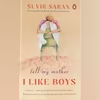 "book review")
premium
Tell My Mother I Like Boys
5 min read Last Updated : Feb 12 2026 | 10:23 PM IST
Listen to This Article
Tell My Mother I Like Boys
By Suvir Saran
Published by Penguin Random House
240 pages ₹699
It is rare to hear someone talk about their birthday and matters of public policy in the same breath. The two subjects seem to belong to entirely different realms but they come together in an unusual way in chef and restaurateur Suvir Saran’s memoir Tell My Mother I Like Boys.
As the title suggests, sexuality is discussed here without euphemism or exaggeration. However, this book is not exclusively about his life as an out gay man. It is also about being raised in a loving multigenerational family, challenging normative ideas about masculinity, pursuing his calling as a chef, and nurturing his creative gifts.
Mr Saran, who shot to fame for his work with Devi, the first Indian restaurant in North America to earn a Michelin star, writes, “I was born on 29 November 1972 in New Delhi at a time when ‘Hum Do, Hamaare Do’—us two, our two children — was the new anthem of family planning. I was not the planned child. I was the accident meant to be erased, the pregnancy intended for a clinic, not a cradle.” His eloquent acceptance of this fact shows how vulnerability and strength could be viewed as two sides of the same coin.
Mr Saran adds, “And yet, through a twist of fate, I was kept. How grateful I am for that mercy — for the chance to live, to falter, to fall, to rise, to tell this tale!” His appetite for truth-telling, matched with style, adornment, and emotional intelligence, result in a narrative that alternates between sombre and breezy. In his universe, coming out is not a confession but a celebration. Yet there is no attempt to downplay hurt and heartbreak.
One feels furious on his behalf while reading his account of a former lover who was “rugged, raw and achingly beautiful” but turned out to be a thief. That man stole the author’s money, antiques, and computer, then became uncontactable. This incident reminds one of Sameer, played by Saif Ali Khan, in Farhan Akhtar’s film Dil Chahta Hai (2001), who is robbed by the very woman with whom he has a vacation romance in Goa.
Mr Saran followed another former lover from Delhi to New York, hoping to build a life together, echoing the longing-laden song that Anand Bakshi wrote for Rajiv Rai’s film Vishwatma (1992): Saat samundar par main tere peechhe peechhe aa gayi (I’ve chased you across the seven seas). Unfortunately, the man freaked out and fled after seeing the two silver rings that Mr Saran had brought to signal his readiness for a deeper commitment.
The author also writes movingly of the pain that springs from feeling out of place in the world. “Even as a child, I sensed there was something different about me, something I couldn’t yet name but felt deeply.” During his early years in Nagpur, his family lived close to a cremation ground. As he saw the flames from the pyres dancing in the distance, his mind filled up with questions: “Who would mourn me when my time came? Who would carry my body if they knew my truth?”
These questions are existential at one level, but also rooted in a pragmatic outlook. The lack of legal recognition for same-sex marriage in India makes it terribly difficult for gay men to find a stable source of companionship in partners acknowledged by both state and society. Moreover, the legal obstacles placed in the way of adopting a child add to the growing sense of despair.
It seems brutally unfair that a child should have to face the enormity of this anticipatory grief but it is understandable because children have the ability to imagine future selves based on the adult lives they witness in their surroundings. This book sheds light on these subtle shades of loss, and eventually transforms into a victory song for those who feel ignored, forgotten, unloved, unwanted.
Cooking brought meaning to his life in New York. “My apartments became laboratories of life, perfumed with spice and smoke, echoing with laughter and lament, humming with hunger and healing,” writes Mr Saran, whose words are meant to be tasted, nibbled and devoured, not just read. “Around my tables, I recreated the India I carried within me: a place where less became more, where contradictions coexisted, where belonging was made rather than found,” he adds.
The book also chronicles how his creative life has kept him whole through setbacks that threatened to crush his spirit. He writes, paints, knits, embroiders, and learns Hindustani classical music. “When the world felt too sharp, I sought solace in the soil,” writes Mr Saran, reminiscing about the dahlias, roses and chrysanthemums he once planted. Those who are about to give up on themselves will find courage in his words.
The reviewer is a journalist, educator and literary critic. Instagram/X: @chintanwriting