


Can Tesla sell a Rs 20-lakh electric car produced in Indian giga-factory?
Tesla Founder Elon Musk's ambition to build a high-volume affordable car is not new
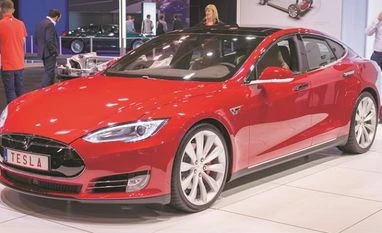 "Tesla deliveries set a record and extend red-hot run for shares")
premium
6 min read Last Updated : Jul 19 2023 | 7:18 PM IST
In discussions with the government a few weeks ago Tesla reportedly sprang a surprise. It said it would sell its electric car for Rs 20 lakh in India and set up a plant with an annual capacity of 500,000 units.
With that, the company has sparked a new debate. It has models that retail at a starting price of around $41,900 (Rs. 34.39 lakh) in the US and had lobbied for a duty reduction in completely built-up units (CBUs) imported from China just a year ago — which the Indian government rejected. Can Tesla make an electric car at this price?
Tesla Founder Elon Musk’s ambition to build a high-volume affordable car is not new. In 2020, Musk had announced that he would come up with a $25,000 (Rs. 20.5 lakh) car in three years. That did not happen.
But the ambition to build a compact or subcompact car that has a large market in Asia and Europe fits in with broader ambitions. By 2030, the company plans to sell 20 million Teslas across the globe from a mere 1.3 million last year. So Musk will need to come out with car models that can be sold in large volumes.
To achieve this, Musk has clearly said he will need 10 to a dozen giga-factories beyond the five located in the US, China and Germany. One of them could be in India, though Musk has been scouting other venues from Indonesia to South Korea and Latin America.
The market for compact affordable electric cars is expected to boom globally. In five years, estimates suggest that this market would hit over 10 million units. As many as 60-odd model launches are expected in this space in a few years, apart from the ones that are already making a dent in the market, such as the Bolt EV from Chevrolet (priced at $26,500), the Nissan Leaf ($28,400) or Kona Electric ($33,000). Volkswagen has announced a sub-$28,000 model just a few months ago. In short, it’s a market that Tesla would not like to lose.
But why India? The domestic market for cars priced above Rs 20 lakh is small. Indian manufacturers sell around 30,000 premium cars (that too, the ICE version) a year in a 3.8-million overall market. And electric cars are in their infancy accounting for a penetration of just over 1 per cent despite the fact there are already sub-Rs 10 lakh cars from the Tata stable. Hyundai, which recently launched its top-end electric SUV Ioniq (at around Rs 45 lakh) has sold only 500 units in six months while Hyundai’s Kona (Rs 23 lakh upwards) sells 60-80 vehicles every month.
Tesla, said experts in the business, is looking at replicating Apple’s strategy in India, which is focused on exports, bringing in its supply chain to India and selling its premium phones that were earlier imported and now mostly made in India for the domestic market.
So Tesla plans to clearly give up its earlier plan on importing a CBU car (where import duties are between 70 and 100 per cent) just like Apple did, which moved from importing to assembling in India, even the latest iPhone 14. Tesla is now looking at assembling the model in India through the completely knocked down or CKD (on which the import duty on the parts is 10 per cent). Apple assembles its phones through its contract manufacturers in India.
Tesla’s focus, those in the know say, is to export its cars in other Asian markets, apart from catering to the domestic demand. The government expects electric car penetration to hit 30 per cent by 2030, though analysts would be happy with half that figure. So experts say it is looking at building a giga-factory of 500,000 cars annually — bringing in all its key suppliers — so that it can push cost efficiencies with high volumes.
The key to success will depend on how quickly Tesla can build its supply chain in India and localise. Apple is finding it difficult to bring in its supply chain dominated by Chinese companies because of stiff government rules to discourage their entry in India. But the Austin, Texas-based conglomerate faces no such unique challenges.
That is because it can leverage India’s pre-existing vibrant component and export ecosystem involving all the world’s leading car makers. “Putting up an assembly plant is not too expensive; and Tesla can source many of its requirements from India, such as power seats, the glass, and many other components and increase localisation faster,” said an industry veteran, who has worked with both Indian and foreign car companies.
It can also leverage Panasonic, its largest global supplier for lithium ion batteries globally, which has recently announced plans to set up a battery plant in India for electric vehicles. As battery cells are the key cost in a car, it could speed up Tesla’s localisation efforts.
Tesla has also worked with some Indian companies, which were suppliers to the car-maker. For instance, Delhi-based Sandhar Technologies supplies aluminium pressure die cast parts for wiper systems, and Sona Comstar provides differential gears.
If Tesla’s move to India works out, the company will, like Apple, be able to reduce its dependence on China. Last year, half its cars were made in China’s Shanghai plant and the country accounted for a third of its sales.
Tesla’s entry for India in a new avatar is good news. As the CEO of an auto company that is planning to make electric cars says: “There are still too many open ends. But more global players making in India is good for the Indian industry.”
The strategy book
- Tesla has five giga-factories across the US, Germany and China; it wants to set up 10-12 of them
- It wants to sell 20 million electric cars by 2030 from 1.3 million last year, so it needs an affordable car to yield volumes
- Apart from India it is also looking at Indonesia, South Korea and Latin American countries to set up a plan
- The compact electric car market globally is expected to boom in five years
- Tesla is heavily dependent on China — half its cars are produced there and one-third of its sales come from that market