


India eyes tariff advantage in key US sectors over China, Canada, Mexico
Indian exporters are poised to strengthen their presence in the US market as rivals like China, Mexico, and Canada face higher tariffs ranging up to 50%, as against India's 10%, says NITI Aayog report
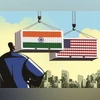 "US India Trade")
India is expected to gain competitiveness in 22 of the top 30 product categories (at the HS 2 level) under the current US tariff regime. | Representational
Listen to This Article
Commerce and Industry Minister Piyush Goyal on Monday said that trade talks between India and the United States are progressing rapidly, as Indian negotiators began a week-long round of discussions in Washington. His remarks came on the same day Niti Aayog released the third edition of its ‘Trade Watch Quarterly’ report, indicating that India is expected to gain competitiveness in 22 of the top 30 product categories (at the HS 2 level) under the current US tariff regime. These categories account for 61 per cent (representing a market size of $49.3 billion) of India’s exports to the US and 68 per cent ($2,285.2 billion) of total US imports.
This competitiveness offers Indian exporters an opportunity to strengthen their presence in the US market, particularly when its global peers face steeper tariff barriers. The Niti Aayog’s assessment assumes that India will face an extra 10 per cent tariff, while many other countries, like China, Mexico, and Canada will face higher tariffs ranging from 20 to 50 per cent. This would enhance India’s market potential in nuclear reactors, iron and steel, textiles, electricals, and vehicles.
At the HS 4 level, India enjoys a favourable tariff differential in 78 of the top 100 products, which together account for about 52 per cent (representing a market size of $42 billion) of its exports to the US. These findings highlight India’s growing export potential to the world’s largest consumer economy, mentions the Niti Aayog report.
While six of the top 30 (at HS 2 level) product categories maintained status quo on tariff, India’s competitiveness remains unchanged. This segments account for 32.8 per cent of its exports to the US worth $26.5 billion, highlighting the scale of opportunity available for Indian exporters. The modest differences open avenues for targeted trade negotiations with the US.
Also Read

 "Donald Trump")
 "Stock market, Indian stock market")
 "India US Trade")
 "Milk industry sounds the alarm as India's production growth sees steep fall")
 "trade talk, India, US")
India’s tariff advantage over China is notable, the report mentions. The average tariff differential stands at 20.5 per cent in India’s favour, enhancing its potential to expand market share at China’s expense. Among the top 10 product categories, leading exporters to the US in the HS 2 product categories like China, Canada, and Mexico, face tariffs higher than India’s by an average of 19.6 per cent.
Further, the analysis of the HS 4 level shows that in around 80 of the top 100 products, competitors face higher tariffs than India, reinforcing its export momentum. These products make up a large share of India’s exports to the US and of what the US imports, offering India the opportunity to expand its market.
Even in categories where India faces higher duties, the tariff differential is typically under 1 per cent, affecting products that make up 24.5 per cent of India’s US-bound exports. This narrow differential reduces India’s competitive disadvantage, especially as countries like China continue to face escalating trade barriers.
As global supply chains realign and trade relationships evolve, India’s comparatively lower tariff burden positions it favourably to capitalise on emerging trade corridors, particularly with the United States. The report recommended that India should focus on important service sectors like financial services and IT while negotiating a trade deal with the US.
Understanding Harmonised System
Under Indian Trade Clarification based on the Harmonized System, HS 2 and HS 4 products refer to the first two and four digits of the Harmonized System (HS) code, respectively. The HS code is a standardised system used to classify traded products, and it’s crucial for customs and trade purposes.
More From This Section
 "inflation, fmcg")
 "Bullet train, train, railway")
 "Piyush Goyal, Piyush")
 "Nirmala Sitharaman, Nirmala")
Don't miss the most important news and views of the day. Get them on our Telegram channel
First Published: Jul 14 2025 | 11:58 PM IST