Addressing the inaugural session of an event on ‘Sustainable Energy Transition-Global Perspective’ here, Mishra said climate finance and technology access are major constraints for the Global South. “India has consistently maintained that climate action must be rooted in equity and climate justice, and that adequate, predictable and affordable finance is essential,” he said.
He also reiterated that the country has consistently argued for recognition of differentiated responsibilities, enhanced climate finance and meaningful technology transfer. Outlining the emerging priorities, he also said system reliability and grid stability will become more complex, as renewable energy deployment increases.
Mishra said clean energy is no longer a sectoral agenda and is central to growth, competitiveness, social inclusion and energy security. India has already reduced the emissions intensity of its gross domestic product (GDP) by about 36 per cent between 2005 and 2020, becoming the first G20 country to meet its Paris Agreement commitments, nine years ahead of the 2030 timeline.
On nuclear energy, Mishra mentioned that allowing private participation in the sector is expected to scale nuclear capacity significantly by 2047 and provide firm, zero-carbon baseload power. Commenting on the efficiency of government policies on clean energy, he said India has achieved near-universal household electrification, ensuring that clean energy expansion coincides with social inclusion.
Mishra also said India's solar manufacturing capacity has expanded to 120 Gigawatt (Gw) since 2022, on the back of the existing Production Linked Incentive (PLI) scheme for solar PV modules.
Commenting on the success of International Solar Alliance (ISA), he said India’s policies have strengthened its role as a global climate leader. ISA, with India as one of its founding members, brings together 112 nations — mostly from the Global South — to promote solar power adoption.


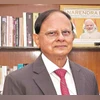 "Mishra said clean energy is no longer a sectoral agenda and is central to growth, competitiveness, social inclusion, and energy security.")