


Gold at $10k, SIP flows, smallcaps outlook: Chris Wood's India mkt playbook
Over a five- or 10-year view, if I were an Indian mutual fund investor, it makes sense to allocate half of your inflows into small- and mid-cap funds, Wood said.
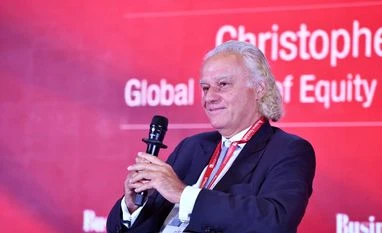 "Chris Wood")
Christopher Wood, global head of equity strategy at Jefferies
Listen to This Article
In the absence of the geopolitical variable, one should get around 15 per cent returns from the Indian markets over the next one year— returns broadly in line with earnings growth, Christopher Wood, global head of equity strategy at Jefferies, told Puneet Wadhwa in an in-person interview at Gurugram on the sidelines of their India Forum. The biggest India-specific issue for foreigners is the capital gains tax in India, he added. Edited excerpts:
With US 10-year bond yields at 5 per cent and US Fed hiking rates, do you see the investment case for equities weakening?
That is a threat to the investment case. In my view, if the Federal Reserve had not raised rates on September 16, the bond market would have been at risk of a bigger sell-off, which could have had a cascading effect on equities. If we comprehensively break the 5 per cent level, that raises the risk for equities.
At what level would the markets become really uncomfortable with US bond yields?
The markets will start getting uncomfortable if we break above the current level. We are right at the key level now, around 5 per cent. If yields were to move towards 5.5 to 6 per cent, I think the market would become very uncomfortable. The stock market wants to ignore rising bond yields, but 5 per cent is a level that becomes difficult to ignore. The reason the US markets have remained so resilient is that earnings growth is very strong.
Also Read

 "stock market live, sensex today")
 "crude oil. oil")
 "NSE, National Stock Exchange")
 "stock market")
 "stock market live, sensex today")
Is there a possibility that you could underweight India further or trim exposure over the next one year?
I have already cut my India exposure over the last two years. That said, I think there is a reason to think about increasing it. If one is underweight Indian equities, this is a good time to increase the stake. But it all depends on how the artificial intelligence (AI) theme plays out. In the last year, I definitely reduced my India weighting, like everybody else. But the decision is driven more by what is happening externally than by developments in India.
Where does India currently stand in your Asia ex-Japan portfolio?
Against the benchmark, I am marginally overweight. The portfolio moves around because the Korean benchmark can be quite volatile.
What could trigger an increase in your India allocation?
The biggest reason to increase the weighting in India would be if you think semiconductor stocks have peaked. Three stocks — TSMC, Samsung and Hynix — accounted for about 29 per cent of the MSCI index as of last weekend. So, the biggest reason to increase India's weight would be if you believe the weighting of semiconductor stocks is going to come down.
The broader point is that the biggest reason to change the view on India, from a foreign investor's perspective in the emerging-market context, is what is happening externally, rather than what is happening in India.
For a dollar-based investor, one of the best reasons today to add to India is the growing potential that the rupee has found a bottom. The successful bond issues are another positive factor.
Has India permanently lost its position as the emerging-market darling?
Before the AI story kicked in — essentially at the beginning of 2023 — India was the best structural growth story around. India is still a good structural growth story, but the whole Indian story is being diluted by the AI theme.
It is not that India has suddenly become negative. Rather, India has become more of a defensive play relative to the overall global AI theme. If people suddenly give up on the AI theme, think it is a bubble that bursts, or if the theme goes south, India will undoubtedly get more attention.
Could the AI bubble burst happen over the next six to 12 months?
It could happen. But right now, estimates of AI capital expenditure are still rising. If I look at the guidance from the four big hyperscalers — Microsoft, Amazon, Alphabet and Meta — we are looking at about $720 billion of capital expenditure in 2026 based on their guidance. Next year, we are looking at $987 billion.
Capital expenditure almost translates dollar-for-dollar into profits for semiconductor companies. So, if this much capex is going to happen over the next one or two years, it has significant implications for the entire investment landscape, including India. The first three years of this capex cycle were primarily financed by cash. From this year onwards, they are increasingly borrowing the money.
What are the biggest India-specific concerns for foreign investors?
The biggest India-specific issue for foreigners is the capital gains tax. The Indian tax treatment of foreign investors is worse than in other markets. So, that is definitely an India-specific negative from the point of view of foreign equity investors.
Aren’t they concerned about corporate earnings in the backdrop of geopolitical issues and its impact on oil prices?
In fact, the earnings data coming out of India over the last six months has surprised positively. Growth has been stronger than expected. When I was in India six months ago, credit growth was around 18 per cent. People were not expecting that. Some of this is a base effect, but it is still stronger than people were expecting.
With the geopolitical situation in West Asia and oil prices rising, are markets underestimating the risk?
Oil has been rising, but I don't think it has risen enough to adequately reflect the risk premium. You get a better idea of the real issue by looking at the diesel crack spread. I think refined products tell you more than just looking at crude oil.
One factor has been China. When this happened, China had big reserves of oil and had been purchasing oil in the preceding months. That has supported the global economy.
There is clearly some demand destruction, partly because of electric vehicles. But my guess is that it is also partly deliberate. China did not want to kill the global economy, but it also has leverage over the situation.
Ultimately, China has much more leverage over the situation than Donald Trump. It has leverage over the oil price and over Iran. Donald Trump does not have leverage over Iran; that has become clear, at least for now.
What is your view on the Reserve Bank of India's (RBI’s) interest-rate trajectory? Has the RBI run out of dry powder to defend the rupee?
My guess is that the RBI could raise rates by 50 basis points (bps) in the next few months. The data has been stronger, as we discussed. I am looking more at credit growth and GST data. I think those are probably the most credible indicators.
The GDP data is a bit more difficult because the methodology has changed, although there is probably also some base effect at work. I would be surprised if the RBI had not raised rates by the end of the year.
Between emerging and developed markets, what would be your preference over the next six to 12 months, and where does India fit into the emerging-market basket?
I would be running India around neutral until we get clear evidence on the semiconductor issue. If I suddenly become convinced that semiconductor stocks have peaked, I would raise my India allocation.
From a global emerging-market context, apart from the semiconductor trade, Brazil is another major market with a potential catalyst next quarter because of the presidential elections in October.
The action in India has been more concentrated in mid- and small-caps. What is your view on these segment?
I think that has always been the most interesting part of the Indian market in recent years. A distinguishing feature of the Indian market is that like in many other markets, small- and mid-cap companies have been ignored because everybody buys the big-cap stocks and the companies that are heavily represented in the indices. You see that in the US. In India, however, the most dynamic part of the market has been the small- and mid-cap sector. India is very different in this regard from most markets.
Do you have a particular sector or theme that you like within the mid- and small-cap space?
I am not really running a dedicated Indian portfolio around that. Tactically, though, small- and mid-caps can outperform. Today, with the Iran war escalating again because of what happened in Yemen recently, I would not be adding to small- and mid-caps. I would have added them when I was last in India, and I said that at the time.
Over a five- or 10-year view, if I were an Indian mutual fund investor, it makes sense to allocate half of your inflows into small- and mid-cap funds. That is where the interesting entrepreneurial companies are. The key question is getting the right fund manager. In small- and mid-caps, the fund manager becomes much more important.
What is your broad view on the technology sector?
These companies are making a lot of money. Samsung's estimated profits this year are about three times the total profits of the Nifty 50. I have 26 per cent in technology and 20 per cent in India. So it is not as if I have nothing in technology, but my weightings are a lot lower than those of most professionals.
How do you see corporate earnings playing out in India over the next six to 12 months?
Corporate earnings are picking up in India. The domestic environment is okay and nominal growth is picking up. The stronger data we have seen this year is partly genuine growth and partly the base effect. But among the big-cap sectors, I agree that the most interesting sector this year is power, partly because of the base effect following the very long monsoon last year.
The other factor is growing private-sector participation in power. There is significant growth in solar, and the move towards electrification that we saw in China is now happening in India. This is an ongoing theme.
So, among the big caps, that is probably the most interesting story. I still like real estate, although the market does not seem to think the real-estate story is as attractive. Another interesting development is the growing activity in the gold-lending market, which should be monetising household collateral and potentially generating household consumption.
What is your outlook for gold?
I think gold is eventually going to $10,000. But we need the Federal Reserve to stop raising rates. The real issue around the Fed, the Treasury and the bond market is that the US simply cannot afford higher rates because of debt servicing.
If bond yields keep rising, at some point between 5 and 6 per cent there will be growing pressure to stop yields from going higher. There could be various measures, such as increasing funding at the short end and buying back at the long end. At a certain point, they may have to fix yields, as the Japanese did. If they fix yields, the pressure will then be on the dollar.
What returns can investors expect from Indian markets over the next one year?
I am hoping the rupee-dollar relationship turns in India's favour. In the absence of the geopolitical variable, you should be getting around 15 per cent returns — returns broadly in line with earnings growth.
One of the big problems with the Indian market at the index level is that the index is capped. The moment the market gains momentum, you get equity supply (IPOs). August was a big month for supply, and I think this supply is capping returns.
When the Iran war broke out, equity supply diminished for about three months. Then, over the last two or three months, confidence grew that the situation had peaked and supply came back. I think last month was the biggest supply so far, and supply could rise again if the situation escalates.
If the market remains strong, you are also going to get continuing equity placements, including from private equity investors.
What is your broad outlook for oil over the next one year?
My view on oil is simple: you have to have some energy exposure in a portfolio because it is the only way of hedging geopolitical risk. We could definitely see crude oil go to $120 or even $150 a barrel. Frankly, given the news flow, the surprising thing is that oil is not higher. Partly, that is because of China. Partly, people have been quite good at finding other sources of supply.
What is your reading of the tariff situation as far as India is concerned?
We don't know. Surprisingly, the markets have not reacted too much because they have stopped reacting to Trump. He keeps saying things that do not follow through. I don't really believe he is going to put this 100 per cent tariff on India, but maybe I am wrong.
What is the biggest negative shock that could hit Indian equities from here?
The biggest negative shock to the Indian market today would be if mutual fund inflows suddenly stopped. Everybody understands the oil risk. People are pleasantly surprised that oil is not higher. But if mutual fund inflows suddenly stopped, that would be a major negative surprise. I am not saying it will happen, but if it did, the market would collapse. Then foreign investors would return because valuations would suddenly become attractive. As an investment destination, people are not finding many avenues to invest in, and these mutual fund inflows have become very stable. People are assuming, myself included, that they are here to stay.
Have markets come to terms with structurally higher oil prices?
No. They are still hoping oil prices fall. They are hoping Trump backs up and goes home. The "taco" theme is in the market. The market has definitely not come to terms with higher oil prices. It is also not very good at discounting geopolitics. The Yemen situation is the worst possible news. The latest news is that US vessels are going to help, but I am not sure the US can totally guarantee Saudi vessels getting through the Strait of Hormuz. I could be wrong.
More From This Section
 "Emami")
 "US Fed rate hike impact on Indian stock market")
 "Turtlemint share price target")
 "Tuhin Kanta Pandey, Tuhin Kanta")
Topics : Chris Wood Jefferies Chris Wood US bond markets US bond stock market investing Indian stock markets IPOs Crude Oil Price US crude oil Brent crude Midcap smallcap Nifty IT stocks SIP Mutual funds Market Interviews
Don't miss the most important news and views of the day. Get them on our Telegram channel
First Published: Sep 17 2026 | 1:32 PM IST