


Ideology to identity: West Bengal's religious outreach turns political
Mamata Banerjee's push for temples has led to speculation that TMC is adopting soft Hindutva, even as a former party leader doubles down on building a 'Babri Masjid'
 "Mamata, Hindutva")
premium
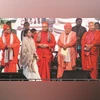
West Bengal CM Mamata Banerjee at the foundation-laying event of the proposed Durga Angan in Kolkata on December 29 | Photo: PTI
6 min read Last Updated : Jan 04 2026 | 10:59 PM IST
Listen to This Article
One temple is done, two are preparing to rise and the foundation for a mosque has been laid. As Assembly elections draw nearer, religion is once again shaping the contours of West Bengal’s political landscape — this time in concrete and stone.
On April 30 last year, Chief Minister Mamata Banerjee unveiled the ₹250 crore state-funded Jagannath Temple in Digha amid much fanfare. Modelled on the iconic Jagannath temple in Odisha’s Puri and spread across 20 acres in Purba Medinipur, the complex has set a new benchmark, drawing around 10 million visitors since its inauguration.
Eight months later, on December 29, Banerjee laid the foundation stone of “Durga Angan” — a cultural complex dedicated to the goddess Durga, to be built on 17.28 acres in New Town, Kolkata. The entire project will be implemented under the supervision of the West Bengal Housing Infrastructure Development Corporation.
Describing it as a “historic” day, Banerjee said: “You may ask what is the necessity of a Durga Angan when Durga Puja is celebrated everywhere in Bengal — it is to preserve the recognition that Unesco has given to Durga Puja for future generations.”
The project cost has been estimated at ₹261.99 crore with funding support from the state government. Banerjee added: “Thousands of people will come here every day.”
Later this month, the CM is expected to break ground for Mahakal temple in Siliguri in north Bengal.
Meanwhile, in the border district of Murshidabad, a parallel religious narrative is unfolding after now-suspended Trinamool Congress (TMC) MLA Humayun Kabir laid the foundation stone for a mosque modelled on the Babri Masjid on December 6.
The religious pot in Bengal is clearly coming to a simmer.
Splitting the electoral base
Kabir was suspended from the ruling TMC after his repeated calls for the construction of a ‘Babri Masjid’ in Murshidabad became an embarrassment for the party. On December 22, he launched his own outfit, the Janata Unnayan Party (JUP) and is keen on forging an alliance with the Indian Secular Front (ISF) and Asaduddin Owaisi’s All India Majlis-e-Ittehadul Muslimeen (AIMIM).
This is the latest twist in a political career marked by party switches. In 2015, he was suspended by the TMC for six years. In 2019, he unsuccessfully contested the general election on a Bharatiya Janata Party (BJP) ticket, before returning to the Trinamool fold in 2021, when he was elected MLA from Bharatpur.
The question now is whether Kabir’s JUP and Babri Masjid plank can chip away at the support from minorities that Banerjee enjoys.
The Muslim population in West Bengal is around 30 per cent of its total. The share in Murshidabad district — which has 22 Assembly constituencies — is at over 66 per cent.
If the mosque fragments the minority vote, a parallel question arises: Might Banerjee’s temple-building push draw away a slice of the BJP’s Hindu-majority vote bank?
Soft Hindutva pitch?
Though presented as a tourism-driven and secular initiative, Banerjee’s temple construction push is being read by political observers as leaning towards soft Hindutva.
Political observer Sabyasachi Basu Ray Chaudhury cautioned that the TMC may get trapped in its soft Hindutva approach. “Its principal opponent, the BJP, can go all out, whereas the TMC will still have to balance this strategy with the need to maintain its secular image,” he said.
Banerjee has walked this path before — in the 2021 Assembly elections, she and her challenger, BJP’s Suvendu Adhikari, each went on a spate of temple visits while campaigning in Nandigram. Adhikari won narrowly, despite Banerjee leading her party to a landslide victory. Months later, she returned to the Assembly from Bhabanipur by a wide margin.
Even as the effectiveness of TMC’s soft Hindutva approach is debated, the rise of identity politics in Bengal is undeniable.
Shifting discourse
According to political analyst Biswanath Chakraborty, the political discourse of West Bengal has totally changed.
“Ideology and issue-based politics has shifted or is being replaced by religion and identity-based politics. All political parties are trying to connect with the voters through religious issues,” he said.
Until recently, Bengal was the centre of ideological politics, Basu Ray Chaudhury said. “We had the Left on one side and the Congress on the other. But over the last 10-15 years, the state has increasingly emerged as the new centre of identity politics — whether it is the Rajbanshis in North Bengal, Nepalis in the hills or the Adivasis in Junglemahal. This awareness has been encouraged by the political leaders,” he added.
Shared cultural space
Bengal has long been known for celebrating festivals across faiths with equal fervour — be it savouring haleem during Eid, thronging Park Street on Christmas, or joining the frenzied rush during Durga Puja.
Religion in Bengal has always been “easy-going”, observed Communist Party of India (Marxist) West Bengal state secretary Mohammed Salim. “The lives of people don’t revolve around a temple, mosque or church — it’s not a core subject in Bengali society. The real question before people now is how deep or shallow their roots truly are,” he said.
Huge pandals are created every year for Durga Puja, but that’s soft infrastructure for religion, Salim added, and not hard infrastructure like temples.
The role of the state in creating such religious infrastructure has also come under scrutiny. As Basu Ray Chaudhury pointed out: “The government’s role is to ensure that there is no discrimination against minority groups. It is not, however, the responsibility of the state to construct temples.”
Political dividend
According to BJP leader Dilip Ghosh, “mandir-masjid” doesn’t move the needle in polls. “West Bengal needs development — it is falling behind the rest of India. Workers are migrating to other states for better opportunities,” he said.
According to Salim, the ruling parties at the Centre and state want to deflect attention from the real issues. “The new generation is fed up with the mandir-masjid card. And in rural areas, people want the politics to be on the question of development, employment, industry, agrarian crisis,” he said.
But the dynamics are driven by a complex set of issues this time and at the centre of this is the special intensive revision (SIR) of electoral rolls by the Election Commission (EC).
On Friday, TMC general secretary Abhishek Banerjee launched ‘Abar Jitbe Bangla (Bengal will win again)’ campaign. He will travel across districts throughout January, and has said he will do his best to ensure that people do not face any trouble due to SIR.
According to Chakraborty, the TMC has positioned itself as a messiah of voters. “Elderly citizens are being summoned for hearings, some arriving on stretchers—these images have stirred strong emotions,” he said.
But what will shape the poll outcome — SIR or the pull of identity politics — remains to be seen.
Topics : Mamata Banerjee West Bengal Assembly polls TMC