


Donald Trump, EU's Von Der Leyen cite conflicting details on trade deal
The European Union said it would accept a 15 per cent tariff on nearly all its exports to the US. Trump told reporters that the bloc also agreed to open up its countries to trade at zero tariff
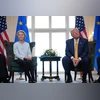 "Ursula von der Leyen, Donald Trump")
Ursula von der Leyen meets with President Donald Trump at Trump Turnberry golf club in Scotland on July 27, 2025 | Photo: Bloomberg


Listen to This Article
By Richard Bravo
President Donald Trump and European Commission President Ursula von der Leyen appear to differ on some key details in their new trade agreement, underscoring the difficulty they may have in turning this deal into a reality.
The European Union said it would accept a 15 per cent tariff on nearly all its exports to the US. Trump told reporters that the bloc also agreed to open up its “countries to trade at zero tariff.”
After he met with von der Leyen Sunday, Trump said that the deal would not include pharmaceuticals, a contentious point in the negotiations, seeming to imply they would be subject to a higher tariff.
In a separate news conference, von der Leyen said, “The EU agreed we have 15 per cent for pharmaceuticals.” But she added, “Whatever decisions later – by the president of the US – that’s on a different sheet of paper.”
Also Read

 "Donald Trump, Trump")
 "US TARIFFS, RETAIL")
 "Jairam Ramesh, Jairam")
 "Donald Trump, Trump")
 "Kamala Harris, Kamala, Harris, Donald Trump, Trump")
Senior US officials later said that the two sides agreed on a 15 per cent tariff level for the EU’s pharmaceutical exports. A separate Section 232 probe on pharmaceuticals is still coming over the next three weeks, but the EU tariff level will remain at 15 per cent, the officials added.
The US has initiated investigations into whether the import of certain products, such as aerospace and semiconductors, poses a national security threat to the country. This could lead to separate tariffs on some sectors.
Trade accords typically require years of negotiations and can run thousands of pages long. Talks on the preliminary agreement clinched on Sunday began in April and concrete details appear scant.
The EU and US also diverged on another controversial sector, with Trump saying that the 50 per cent tariff on steel and aluminum “stays the way it is.” Von der Leyen said that metal “tariffs will be cut and a quota system will be put in place.”
The deal doesn’t cover the EU’s steel and aluminum exports, which will remain subject to 50 per cent tariffs, according to senior US officials. Aerospace tariffs, meanwhile, will remain at 0 per cent pending the outcome of a Section 232 probe, the officials added.
Von der Leyen argued that she won certainty and stability for companies on both sides of the Atlantic. But it’s far from clear that the EU and US will be able to iron out all their differences on the many contentious issues yet to deal with.
“The focus will now turn to interpretation and implementation risk, posing a mix of political and technical questions,” Carsten Nickel, deputy director of research at Teneo, wrote in a note. “Given the nature of the deal, major uncertainties are likely to persist.”
More From This Section
 "Gazans, Gaza aid, Israel-Gaza war, Palestinians")
 "Kim Yo Jong, Kim Jong Un's sister")
 "Exports, Export")
 "Bashar Al-Assad, Syrian President, Assad")
 "bond markets, bonds, bond market")
Topics : Donald Trump EU US trade deal European Union
Don't miss the most important news and views of the day. Get them on our Telegram channel
First Published: Jul 28 2025 | 7:48 AM IST