


G7 to counter China's economic sway, rare earth dominance, says Klingbeil
Beyond economic resilience, the G7 faces broader strategic concerns over its declining influence in the Global South, as China and Russia strengthen ties in regions like Africa
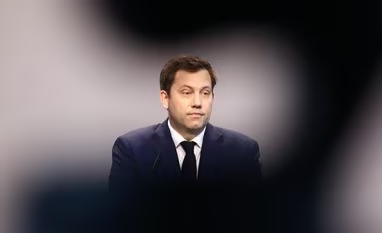 "German finance minister Klingbeil")
He pointed to the European automotive industry’s dependencies, a sector of major importance for Germany’s export-oriented economy | Image: Bloomberg
Listen to This Article
By Kamil Kowalcze
The Group of Seven has agreed to ramp up collective efforts to counter China flooding the global markets with its overcapacities, mounting concerns over critical supply chain vulnerabilities and Beijing’s grip on rare earth minerals, according to German Finance Minister Lars Klingbeil.
“The question of China played a role at this morning’s G7 meeting, it concerns the issue of overcapacity,” he told reporters on Friday.
Speaking on the sidelines of a Group of Twenty gathering at a beach-side resort close to Durban in South Africa, Klingbeil — who also is his country’s vice chancellor — highlighted that “we discussed very intensively with South Korea and Australia, who were also present this morning, how dependent are we on raw materials and rare minerals, how vulnerable does this make our supply chains.”
Also Read

 "The US Treasury building in Washington")
 "Donald Trump")
 "PM Modi, Mark Carney")
 "PM Modi, G7 summit")
He pointed to the European automotive industry’s dependencies, a sector of major importance for Germany’s export-oriented economy.
“We have agreed within the G7 that we will take the lead and look at how we can take stronger action against junk products,” Klingbeil said, referring to Chinese products which are becoming increasingly prevalent in Europe.
Besides the call for more economic resilience lies a broader strategic anxiety of the Western alliance: the G7’s waning influence across the Global South, with China and Russia deepening partnerships in regions such as Africa.
“There are concerns that the G7 are losing influence within the G-20 world and that players such as China and Russia have established partnerships there,” Klingbeil said. He stressed the urgency of proactive engagement to counterbalance Beijing and Moscow’s growing geopolitical foothold.
More From This Section
 "United States Department of Justice")
 "Hubble Space Telescope has spotted a huge galaxy called LEDA 1313424")
 "flights, planes")
 "Donald Trump, Trump")
 "Jack Dorsey listens during the Bitcoin conference")
Topics : G7 G7 summit China Germany European Union
Don't miss the most important news and views of the day. Get them on our Telegram channel
First Published: Jul 19 2025 | 1:09 PM IST