


Cracked homes, tilting mosques: Iran's land is sinking at record rates
Iran's land is collapsing under years of drought, overuse, and poor planning, putting millions, critical infrastructure, and world heritage sites at risk
 "Iran water crisis")
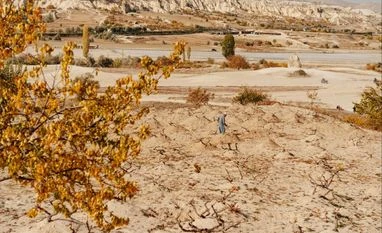
Iran suffers from one of the worst rates of land subsidence in the world (Photo: X/@UNESCOWWAP)
Listen to This Article
Iran is sinking—literally—and the consequences are becoming impossible to ignore. From cracked homes in Tehran to damaged Unesco heritage sites, land subsidence is now a national crisis, driven by climate change, prolonged drought, and decades of poor water management, reported Financial Times.
According to experts, Iran suffers from one of the worst rates of land subsidence in the world. Massive cracks are threatening vital infrastructure, including Imam Khomeini International Airport and the ancient ruins of Persepolis. In some areas, the land is sinking at a staggering rate of up to 31 cm per year, according to Iran’s National Cartographic Centre. International benchmarks raise concern at just 5 mm annually.
In Tehran and surrounding areas, the effects are dire. Railway lines have warped, power towers lean precariously, and homes are becoming unstable. Even schools have been evacuated in some cities for fear of collapse.
In response, President Masoud Pezeshkian floated a dramatic idea: moving the capital from Tehran. He called the combination of sinking land and worsening water shortages “menacing” and warned that Tehran is becoming “unlivable”. While experts say relocating the capital is impractical, his comments have reignited debate about the scale of the threat.
“Subsidence has become a huge challenge,” said Mehdi Pirhadi, a Tehran city council member. “Massive land sinking will destroy infrastructure and threaten lives” if urgent action isn’t taken.
Also Read

 "Iran, Iran flag")
 "Ayatollah Ali Khamenei,Iranian supreme leader")
 "ATTACK, DEFENCE FORCES, PAHALGAM ATTACK")
A problem with years in the making
Environmental activists and scientists say the issue is rooted in years of unsustainable development. Excessive farming, unchecked urban sprawl, and industrial overreach have drained aquifers and dried up dams, especially in central regions like Isfahan. That’s not just sinking the ground—it’s also turning fertile regions into desert.
According to a global study, Iran ranks among the top five countries most affected by land subsidence. The threat touches 11 per cent of the country’s landmass, affecting nearly half of Iran’s 90 million people, according to Shina Ansari, Iran’s Vice-President for Environmental Affairs.
“Continuation of past policies in agriculture and urban planning will accelerate subsidence across Iran in the years to come,” warned Mehdi Zare, professor at the International Institute of Earthquake Engineering and Seismology.
Iran’s heritage sites now at risk
Some of Iran’s most treasured cultural landmarks are also in danger. Deep fissures have been spotted around Persepolis and Naqsh-e Rostam, ancient royal sites that date back 2,500 years.
In Isfahan, cracks are forming in the Unesco-listed Jame Atigh Mosque and structures in Naghsh-e Jahan Square, including the Abbasi Mosque, where its eastern and western columns have tilted by 5 cm and 8 cm, respectively.
Bahram Nadi, professor of geotechnical engineering at Islamic Azad University, blamed the problem on “untamed urban sprawl, industrial development, and excessive farming.”
Unesco is now watching closely. Hassan Fartousi, secretary-general of the Iranian National Commission for Unesco, said the organisation would offer help to preserve Iran’s heritage. However, he warned that world heritage status could be revoked if international preservation standards are not met.
More From This Section
 "Mark Mobius")
 "ArcelorMittal Nippon Steel")
 "Cardinal Lazzaro You Heung-sik")
 "Adidas")
 "North Korea, Russia, North korea flag, Russia flag")
Topics : Iran Tehran Drought BS Web Reports
Don't miss the most important news and views of the day. Get them on our Telegram channel
First Published: Apr 30 2025 | 5:27 PM IST