


Trump admin warns Peru over sovereignty threat from Chinese port
The Chancay port on Peru's Pacific coast was conceived as a crucial new trade link between Asia and Latin America, but its status as a flashpoint between Washington and Beijing is intensifying
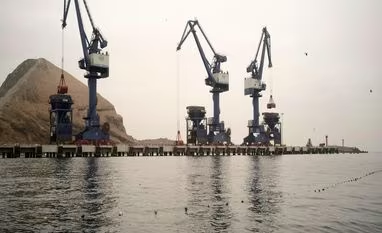 "Cranes operate at the Chancay Port in Chancay, Peru.")
Cranes operate at the Chancay Port in Chancay, Peru. Image: Bloomberg
Listen to This Article
By Marcelo Rochabrun
The Trump administration warned that Peru is losing sovereignty over a Chinese-owned port near its capital city, after a local judge ruled that the port is exempt from some regulatory oversight.
The sprawling Chancay port on Peru’s Pacific coast was conceived as a crucial new trade link between Asia and Latin America, but its status as a flashpoint between Washington and Beijing is now intensifying, as Donald Trump seeks to project US power across the Americas.
“Concerned about latest reports that Peru could be powerless to oversee Chancay, one of its largest ports, which is under jurisdiction of predatory Chinese owners,” the US State Department’s Bureau of Western Hemisphere Affairs wrote in a Wednesday post on X. “Let this be a cautionary tale for the region and the world: cheap Chinese money costs sovereignty.”
The warning is the most direct criticism yet from the Trump administration of Peru’s close ties to China, which is the South American nation’s top trading partner followed by the US. At issue is the Chancay port, which cost $1.3 billion to build and was inaugurated by Chinese President Xi Jinping in 2024. The port helps to expedite shipments to China from South America, and is operated by Chinese-owned Cosco Shipping Ports.
Also Read

 "Gordie Howe International Bridge")
 "US flag, US, united states")
 "oil pumpjack, crude oil, venezuela, oilfield contractors")
 "Karoline Leavitt, US press secretary")
 "Donald Trump, Trump")
“Chancay is not an enclave. It’s not a place where the Peruvian state has no sovereignty,” Gonzalo Rios, the port’s adjunct general manager and a retired Navy admiral, told Bloomberg in an interview. He said a host of state entities regulate port activities, including customs, and that the dispute singled out by the US is limited to the infrastructure regulator.
The local ruling states that infrastructure regulator Ositran does not have oversight over Chancay. Ositran regulates Peru’s other major ports, which are concessions on public land, but Chancay is a privately-owned port.
Ositran head Veronica Zambrano has criticized the decision, arguing it will leave users of the port unprotected. She told local media that Chancay requested that it not be supervised by Ositran and that a lower court judge granted the request.
Rios explained that Ositran’s role would be limited to helping users in case of a dispute with the port, but that it came at a cost of 1% of all sales. Those extra costs were not included in Cosco’s original calculations when it decided to invest in Chancay.
He noted that the port has been paying the fee, but under protest, although the amount is growing significantly as operations ramp up. Rios added that users have other mechanisms to resolve potential conflicts with Chancay and that the port hopes to provide a level of service that can avoid complaints.
China has invested heavily in Peru in recent years, including in the power and mining sectors as well as shipping. Meanwhile, the US has designated Peru as a major non-NATO ally and is negotiating a contract worth as much as $1.5 billion to be paid by Peru to build a new naval base for the Andean country a short distance from Chancay.
Newly installed US Ambassador to Peru Bernie Navarro also criticized what he sees as a hit to Peru’s independence.
“Everything has a price. In the long term, what was cheap is costly,” Navarro wrote on X. “There is no higher price to pay than losing sovereignty.”
He also recently posted a photo with President Jose Jeri eating cheese burgers, a meal he dubbed “changing the menu.” The phrase was widely seen as a reference to unreported meetings that the Peruvian leader held in Chinese restaurants.
More From This Section
 "Donald Trump, Trump, Benjamin Netanyahu")
 "Bangladesh, Bangladesh Flag")
 "social media apps, facebook, meta instagram")
 "Donald Trump, Trump")
 "Italy")
Topics : Trump administration Trump govt Peru
Don't miss the most important news and views of the day. Get them on our Telegram channel
First Published: Feb 12 2026 | 7:46 AM IST