5 min read Last Updated : Nov 21 2019 | 4:22 PM IST
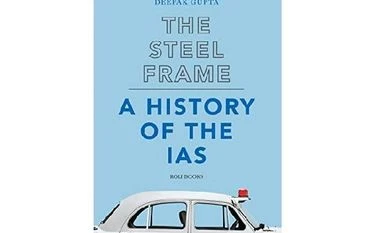
The Steel Frame: A history of the IAS
Deepak Gupta
Roli Books, Rs 695, Pages 282
You will make very little sense of the Indian economy without a clear insight into how the Indian Administrative Service (IAS) operates. Compared with the US, where the role of the civil service is restricted vis-a-vis the economy, and China, where the mandarins of Beijing direct every possible aspect of the economy, the reach of Indian officialdom is somewhere in between. What has also stumped investors and analysts is that the reach of the service has expanded, in lockstep with the expansion of the economy.
This expansion is often not understood but has often tripped up investments into the economy. Two examples from the tenures of the United Progressive Alliance (UPA) and the National Democratic Alliance (NDA) show how it works.
UPA Finance Minister Pranab Mukherjee announced retrospective taxation on overseas purchases of Indian-registered companies, that impacted Vodafone, Cairn and a good many others. It is no secret that it was not Mr Mukherjee but the revenue secretary, R S Gujral, who had spearheaded the tax. The other is the more recent rules for e-commerce. Although few NDA ministers have made any pronouncements on it, the details have been dished out by the officers of Udyog Bhawan (office of the department of industrial policy and promotion), to create new challenges for Amazon and Walmart’s investments in India.
In short, the IAS matters. It matters, even as a political force; it matters even in the operations of the other central services. Few important constitutional positions were outside the ambit of the IAS till recently. To the ranks of the Comptroller and Auditor General, the Chief Election Commissioner and the Central Information Commission, one could soon add the Lokpal. Few regulators remain untested by this service.
Yet when one reads The Steel Frame: A history of the IAS by former Union Public Service Commission (UPSC) chairman Deepak Gupta few of these perspectives emerge. Mr Gupta has taken pains to collect details from the era of the Indian Civil Service, the precursor established by the British. Almost 100 pages of his 282-page book comprise a recital from those times. There is even a subsequent chapter on the “character and traditions of the ICS and IAS”. And another one on the idyllic life of district magistrates during the British era. “The new districts have much smaller houses and gardens. In the compounds of older districts additional houses have been built…The paraphernalia of the Raj has gone away and the DO’s (district officer) personal life, one could say, has been democratised”. How relevant is this in 2019?
The book consequently loses track soon. It plods through the familiar terrain but nowhere does the author describe any personal evidence of how he handled some of those concerns as secretary in the ministries at the centre or recount any first-hand narrative. He relies only on reports by several commissions and quotes other books to make his point. For instance, he makes a valid case that care has to be taken in selecting who among young IAS officers are posted as collectors of a district. Then he only adds: “it is really important that the collector be selected very carefully. Some even say that the fact of the collector being so selected should become a conscious recognition of his overall worth. Unfortunately sending trainees to the districts has become a routine exercise. I would think that the director of the academy take up through telephonic discussions with the chief secretary, the selection of collectors”.
Nowhere does he look upon the role of politicians with approval. Yet in a democracy, it is the politicians who are responsible to the people. The IAS or any other of the 45-odd central services are only there to ensure this responsibility is served well. Since independence, successive political parties in the states and at the Centre have to their credit improved the well-being of the ordinary Indian, creating a welcome surge in aspirations. Admittedly, there are plenty of white spaces still to cover. At the other end is an entrepreneurial India chafing at regulations that are often slow to keep pace. The IAS has to be judged on how well it has kept pace with the challenges. Mr Gupta refers to policies gone wrong and right, but offers little insights except to say that those “where the political executive has a clear and genuinely held policy view, the civil servant usually does deliver”. Whose role is it to develop such clarity?
Such questions are all the more surprising since he has been the chairman of the UPSC where many of these debates should have occupied centre-stage. As a constitutional body, it had the space to do so. But one scarcely recalls any major open discussions that have been organised under its rubric, under him or before, to discuss these issues. Instead, Mr Gupta expends another large segment of the narrative to challenge the supposed erosion in the primacy of the UPSC principally over the demands for lateral entry into the service and a proposal by the department of personnel and training to allocate services to candidates not at the point of recruitment but after their post-induction foundation courses. For any ill, he dives into the past for guidance rather than offer a new set of options. This is where the book fails.