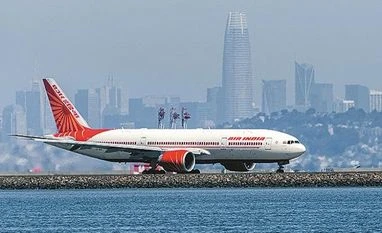
The Air India group -- which comprises Air India, Vistara, Air India Express, and AirAsia India -- is the biggest operator on seven of the top 10 busiest routes in India. But it remains a distant number two, after IndiGo, in the overall domestic market.
The Tata group and Singapore Airlines (SIA) announced on Tuesday that Vistara will be merged with Air India to create a single full-service airline, with SIA holding a 25.1 share in the new entity. AirAsia India is already in process of merging with Air India Express to create a single low-cost subsidiary of Air India.
Before any airline merger approval, the Competition Commission of India (CCI) analyses air traffic between “point of origin and point of destination (city pairs)” to see what kind of market share the merged entity will have there, according to senior competition lawyers.
The aforementioned seven routes where the Air India group is the leader in terms of weekly flights are Delhi-Mumbai, Delhi-Bengaluru, Mumbai-Bengaluru, Mumbai-Goa, Delhi-Pune, Mumbai-Chennai, and Delhi-Srinagar. This dominance can help the Air India group to attract corporate traffic that does not mind spending big bucks to purchase seats, especially in premium economy or business class cabins.
Overall, IndiGo and the Air India group currently operate 10,196 flights per week and 4,826 flights per week in India, respectively, positioning them at the first two spots in the domestic aviation market, according to aviation analytics company Cirium's data.
However, on the Delhi-Mumbai route, India's busiest, the Air India group is currently operating 344 weekly flights, versus 214 weekly flights by IndiGo. On Delhi-Bengaluru, India's second-busiest route, the group is currently operating 92 weekly flights more than IndiGo. The Tata group did not respond to queries sent by Business Standard on this matter.
Mumbai-Bengaluru is India's third-busiest route where the Air India group currently operates 40 more flights than IndiGo. On Mumbai-Goa, the former is operating 108 weekly services, 44 more than IndiGo.
Ameya Joshi, aviation analyst and founder of aviation blog Network Thoughts, said: “A dominant carrier can dictate pricing to some extent. But with as many frequencies, Air India will be in a position to attract corporate traffic like never before. Corporate traffic looks for multiple frequencies, among other things.”
Of the top 10 busiest domestic routes, IndiGo maintains dominance on only three: Delhi-Kolkata, Delhi-Hyderabad, and Delhi-Ahmedabad. Even there, the Air India group would be giving tough competition to India's largest airline.
For example, on the Delhi-Kolkata route, the Air India group is currently operating 126 weekly flights, versus IndiGo's 169. On Delhi-Hyderabad, the group is operating 126 weekly flights, 12 fewer services than IndiGo. On Delhi-Ahmedabad, the Air India group is operating 93 weekly flights, 15 fewer than IndiGo.
The Tata group took charge of Air India and Air India Express from the central government on January 27.
Singapore’s competition commission in June raised concerns with the Tatas over its acquisition of Air India, as the conglomerate owned two of the three key airlines that operated flights on the Singapore-Mumbai and Singapore-Delhi routes. Air India, Vistara, and Singapore Airlines were the three key airlines that operated on the two aforementioned routes.
In June, Vistara's 51 per cent stake was held by the Tata group and the remaining 49 per cent was with Singapore Airlines.
G R Bhatia, head of competition law practice and partner, Luthra & Luthra Law Offices, said: “The CCI. while examining the merger (of Air India and Vistara), will look into various aspects, including the market share of the resultant entity in various city pairs that you have mentioned (seven aforementioned routes).”
And if the CCI feels that the airline's market share is too high, it may approve the merger subject to remedies, Bhatia added.
Broadly the remedies are “structural” and “behavioural”, or a mix of the two. “The structural (remedy) could be to hand over a few slots of city pair to another airline. The behavioural remedy could be that after the merger, the new entity would not reduce the number of seats or number of flights to firm up airfare,” he mentioned. By doing so, the fabric of competition is maintained and competition concerns are eliminated.
"In any case, it is unlikely that the proposed merger would be blocked by the CCI,” Bhatia noted.
Vaibhav Choukse, partner and head of competition law practice at JSA, said: “In airline mergers, the CCI try to ensure continued competition on all routes affected by the merger/alliance. To examine airline mergers, the CCI uses an internationally accepted ‘point of origin/point of destination (O&D)’ pair approach."
According to this approach, every O&D pair should be considered to be a separate market from the customer’s viewpoint, he mentioned.
"For example, the Delhi-Pune flight route would constitute a separate market and the CCI would see whether, after the merger, the combined entity faces enough competition. Hence, market shares will play an important role in this assessment," he said.
If after examination, the CCI feels that there are competition concerns, it can impose a set of remedies that have the effect of making a new entry possible as a condition for approval, Choukse added.
“However, where the network overlap is substantial, and economic benefits in relation to the harm to competition are rather low, prohibition of the transaction may be the only answer, in the absence of effective remedies,” he mentioned.
Bhatia said the existence of dominance is not bad but abuse of dominance is prohibited. "If after a merger, the merged entity is found to be abusing its market position, the CCI post enquiry can issue cease and desist order, impose a penalty on delinquents and pass such other orders for faster correction of marketing practices," he added.