Two years earlier, Shipra from Bengaluru decided to work from home. However, she often finds it difficult to juggle between her work and running errands for home — picking vegetables, fruits and flowers from stores that don’t deliver, clothes from a dry-cleaner or sending couriers.
Last year, she started using dunzo. This is a personal concierge and delivery service that runs an assortment of errands for users like her or fetches your mobile charger that you forgot at a friend’s place. Initially launched on WhatsApp in 2015, Dunzo dow handles 3,500-4,000 tasks a day. Earlier this month, Google led a $12.3-million investment in the Bengaluru-based start-up. The round also saw participation from its early investors Aspada Investments and Blume Ventures. “The partnership with Google’s Next Billion Users team perfectly compliments dunzo’s vision of becoming a one-stop-shop for discovery and fulfillment of all local tasks for the existing and the next generation of internet users in India,” Aspada said in a statement.
In 2015, dunzo ran beta tests on WhatsApp to gauge the demand of people wanting to hire people to run errands for them. The founders noticed high demand for people wanting get groceries delivered from offline stories or an item picked up from a friend’s place.
Back then, co-founder Kabeer Biswas performed the to-do tasks for users on his personal scooter. “We learnt that for our user, what took up most time was the effort of travelling distances and searching for a particular product locally. Think of a to-do list, which completes itself. That’s dunzo for you,” says Biswas.
dunzo created a one-stop application to fulfil to-do tasks for offline purchases in India. It comes to rescue when you are piled under a host of responsibilities and have little time. It performs up to 100,000 tasks each month and about 3,000 every day.
Asked how it is different from BookMyChotu and DoneThing in Delhi, Chief Financial Officer Warner Queeny says, “They rely on merchants, whereas we have 1,350 riders active for completing tasks.”
The start-up claims to have logistically broken even in Bengaluru, saying delivery charges cover the logistics costs per delivery.
The ideal market for the company would be any urban internet user. “We are targeting anyone in India who values their time and is willing to pay a small fee to get some of that time back from lower value tasks,” says Biswas.
As dunzo plans to push demand and on-ground supply, it also envisages using the funding in mapping city-based centres through partnership with local merchants. It claims it is technologically and manually equipped to be able to cater to the next 10 million customers in India, who might adopt dunzo in the next six to seven months. But, it is a tricky segment; several players in the concierge field have either shut down or been sold off. Food delivery giants Zomato and Swiggy have eaten a larger bite of the food-catering market in India. Some concierge services that are similar to dunzo have had a mixed fortune. BookMyChotu, for instance, saw high demand during the demonetisation drive last year. When bank ATMs were running dry and people were forced to form long queues to withdraw cash, BookMyChotu enabled hiring of people to stand in line on their behalf.
The start-up earns revenue by charging people on the task they wish to perform and the distance it would have to cover. It has tied up with multiple partners and merchants and has 1,350 riders for completing the tasks. In Bengaluru, the charges commence at Rs 45 for the first three kilometres and Rs 15 per km then onward. In Pune, where it launched next, the charges are marginally lower — Rs 25 for the first three km and Rs 10 a km after.
“We look at the number of tasks completed each month as the primary milestone. We are very focused on our unit economics and want to make sure we are growing aggressively, while managing our margins,” says Biswas. The app was earlier only available in Bengaluru; it recently extended services to Pune. The company is eyeing expanding into eight major cities, including Mumbai, Delhi and Kolkata.
- Founded: 2015
- Area of business: Concierge services
- Co-founders: Kabeer Biswas, Ankur Agarwal, Dalvir Suri and Mukund Jha
- Funding: $12.3 million in Series-B funding, led by Google
EXPERT TAKE: Local commerce the next frontier for tech firms Anshoo Sharma, Co-founder & CEO, magicpin
Local commerce is a massive market and the next frontier for technology companies. The use case of short turn around deliveries that dunzo has gone after will have high repeat rates and an opportunity to build a great consumer brand.
However, it is expensive and operationally complex to solve this problem. Also, the food market is extremely competitive, as it already has existing players who might be solving the segment's problems more deeply. Dunzo's has done a great job of building strong execution capability here. Access to capital and capability from Google gives the company an opportunity to get to a scale where the economics could become favourable.

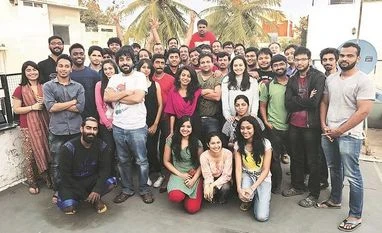 "Google-backed task fulfillment start-up dunzo runs errands to make money")












 Connect with us on WhatsApp