Over the past year, the fortunes of the two brothers at the helm of India’s wealthiest dynasty have grown apart -- to about $40 billion apart.
Elder sibling Mukesh Ambani, 61, toppled China’s Jack Ma as Asia’s richest man, after driving a telecommunications revolution in India that propelled his petrochemicals conglomerate Reliance Industries Ltd. into the $100 billion club. His personal fortune had swollen to more than $40 billion as of Friday, according to the Bloomberg Billionaires Index, billions ahead of Ma and at similar levels to Microsoft Corp.’s former chief, Steve Ballmer.
Meanwhile, Anil Ambani, two years his junior, has had a difficult year, with some of his businesses suffering legal and liquidity challenges that roiled stocks, cutting his personal fortune by almost half to $1.5 billion, according to the index.
A non-compete clause between the brothers kept Mukesh out of that arena until the agreement was scrapped in 2010. Mukesh quickly returned, pumping in more than 2.5 trillion rupees ($34 billion) over the next seven years to build a speedier 4G wireless network for his Reliance Jio Infocomm Ltd.
“It was a very, very big bet,” said James Crabtree, a professor at the Lee Kuan Yew School of Public Policy in Singapore and author of the book “The Billionaire Raj,” which examined wealth inequality in India. Jio also gave Mukesh the chance to forge his own legacy beyond the shadow of the businesses he had inherited, he said. “Jio in that sense was an all-in bet.”
“Reliance’s strategy to diversify beyond the energy sector was the biggest game changer,” said Sanjiv Bhasin, executive vice president at India Infoline Ltd. “Mukesh Ambani had the 10-year vision to foresee that data will be the next gold and he invested heavily.”
What financed that investment was Dhirubhai’s old oil and petrochemicals business, which, expanded by Mukesh, still accounts for 90 per cent of Reliance’s profit. Cash flow from the business, together with a blue-chip rating gave Reliance Industries access to a large pool of cheap capital. “Mukesh Ambani has very adroitly used this competitive advantage,” said Saurabh Mukherjea, founder of Marcellus Investment Managers.
“The only options any indebted company has is to sell assets, seek refinancing or get new investors,” said Crabtree in Singapore.
Of Anil’s businesses, shares of Reliance Naval & Engineering Ltd. saw the worst decline this year, losing 76 per cent. Bought in 2015 as part of his bet on defence as the next engine of growth, the warship and submarine maker has proven hard to turn around.
Its loan accounts have been “irregular or substandard” since 2014, the company said in March. The defence contractor is in arbitration with ex-owners over the latter’s alleged breach of some warranties. Auditors in April cautioned against the firm’s ability to survive and two creditors have an ongoing lawsuit to send Reliance Naval into insolvency. In a stock exchange filing in April that sought to allay the auditor’s concerns, the company said it is engaged with its lenders and is confident on reaching a solution “to resolve the financial position of the company and to continue as a going concern.”
Electricity generator Reliance Power Ltd., also part of Anil’s group, has failed to stem a decade of overall decline in its shares since its record IPO in 2008, just as the global financial crisis hit.
The group’s profitable financial services firm Reliance Capital Ltd. has also seen its shares decline this year, despite staying away from bad news.
But the biggest challenge for Anil’s empire came from his brother’s business.
Reliance Communications Ltd., once the flagship of Anil’s portfolio, was battered by the price war Jio started. Last month, Rcom sold its 178,000 kilometre fibre-optic network for 30 billion rupees as part of a disposal that will see it divest of almost all of its wireless assets and exit from the mobile phone business.
The buyer was Mukesh’s Jio.
RCom “was the crown jewel given away to Anil Ambani after the family businesses split,” said Bhasin. “Then the debt and interest burden spiralled.”
In May, a creditor persuaded a court to begin insolvency proceedings for RCom before agreeing to an out-of-court settlement.
Bloomberg News is currently defending litigation brought by Anil Ambani and Reliance Communications in connection with previous Bloomberg reporting.
The sale of RCom assets to Jio brings the saga of the two brothers full circle and sets the stage for the next chapter in the story of one of India’s great business dynasties.
Anil is gradually unwinding RCom’s debts and refocusing the firm toward real estate. This month he told investors that a property development in Navi Mumbai, a planned city across the bay from India’s financial capital, will create 250 billion rupees in value for investors.
“It may be a late coming but at least he is not running away,” said Bhasin, who remains bullish on the group’s infrastructure, finance and power businesses.
Mukesh is gearing up for an even bigger gamble. In July he announced plans for an e-commerce foray that would marry the group’s telecom and retail business to take on global rivals Amazon.com Inc. and Walmart Inc.
A verdict by India’s top court last month barred the non-government use of a national biometric database that telecom operators including Jio had been using to sign up customers. The prospect of a multi-fold rise in verification costs for the telecom company, together with a slump in the rupee and rising oil prices contributed to a 12 per cent drop in Reliance Industries’ stock this month.
Still, the media spotlight has been on Mukesh and his wife Nita, head of the Reliance Foundation, for a very different reason. Both their eldest son and daughter got engaged this year, putting the Mumbai and Bollywood elite on high alert for two epic Indian weddings. Judging by Akash’s lavish engagement party this June in the family’s $1 billion Mumbai home with 27 stories and 600-staff, they won’t be disappointed.

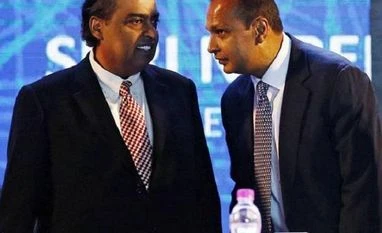 "How the fortunes of Ambani brothers have grown about $40 billion apart")











