M&M to launch electric sedan, mini truck by Feb
The automaker is in talks with Ola to boost sales of the green cars in the country
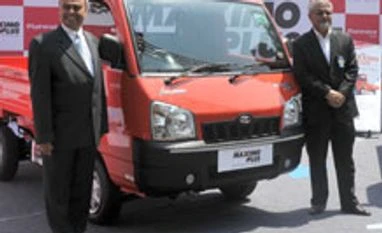
BS Reporter Bengaluru Automobile maker Mahindra & Mahindra will commercially launch electric variants of its Verito (pictured) passenger car and Maxximo mini truck by February and is in talks with cab aggregators to boost sales of more environmental-friendly cars in the country.
Mahindra will use enhanced version of the power train used in its e2o electric car for both the vehicles. The lithium-ion battery-powered sedan would be priced higher than diesel variants of Verito. Mahindra is talking to cab aggregators like Ola to not only find a large customer base but also to popularise electric cars in cities like Delhi where air pollution is forcing people to change their lifestyle. Recently, the Supreme Court banned registration of new diesel cars and SUVs above 2,000cc in the National Capital Region.
Mahindra seems to have taken a two-pronged strategy on this — on one hand, it is planning to launch petrol variants of its famous SUV and MUV models, on the other, it is expanding its electric vehicle portfolio to move towards cleaner fuel.
In Bengaluru, Lithium Urban Technologies is already running an exclusive service of battery-powered cabs. Several multinational companies have shown keen interest in the service where Mahindra e2o cars are factory-fitted with tamper-proof GPS for safety and are connected to high-speed internet.
Mahindra plans to replicate this model in other cities and achieve economies of scale. “We are exploring similar models in other parts of the country,” said Arvind Mathew, chief executive of Mahindra Reva Electric Vehicles.
“If we can scale to 40,000 cars, prices will drop,” Mathew added.
For Maxximo, Mahindra is working with logistics firms across cities to build supporting infrastructure and increase sales.
Mahindra Reva, which has sold around 5,500 cars since its inception, has a manufacturing unit in Bengaluru with capacity of 30,000 units.
India does not make lithium-ion batteries and most of the long lasting batteries are imported from China. Mahindra, Maruti Suzuki and Tata Motors have joined Indian government’s faster adoption and manufacturing hybrid and electric vehicles (FAME) programme to jointly invest and develop common components and systems for electric vehicles.
“We are working on a common standard for all components and systems. It will build the industry and bring down costs,” said Mathew. “Each one of us will have its own IP… software is the IP for individual companies.”
India in April committed Rs 800 crore towards improving the electric vehicle ecosystem — research, creating enabling infrastructure, improving access to lithium-ion batteries and encouraging EV adoption.

 "M&M to launch electric sedan, mini truck by Feb")


 Connect with us on WhatsApp