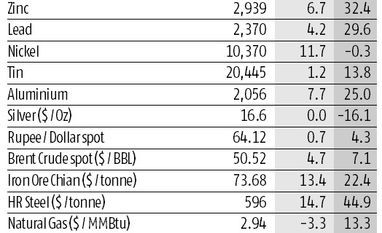
Prices of resource commodities have surged sharply across global markets since July, with raw material and fuel prices going up by 5-15 per cent.
Analysts say this is bound to put pressure on Indian companies' raw material costs, which have been about 45-46 per cent of total production cost during the past five quarters. If the numbers thrown up in the June FY18 quarter are any indication, most commodities are expected to stay at elevated levels.
According to forecasts report by FocusEconomics, a provider of economic analysis and forecasts for 127 countries for 33 key commodities, China's supply management in some commodities has resulted in production cuts. This, along with increasing demand, is likely keep most commodity prices elevated, though some commodities are likely to show signs of moderation. The report says, "Aluminium, nickel, zinc are expected to stay high while copper prices are set to dip this year, after getting slightly ahead of fundamentals. The iron ore market is over-supplied and expected to fall from current $75 per tonne to average $59 a tonne in the December quarter, while the price rise in coking coal is also likely to be shortlived. HR steel prices are set to decline during the second half of the year, owing to ongoing surplus capacity, weak demand, stable prices for steel input and declining global steel prices."
While industries such as steel and auto aren't likely to be impacted by rising commodity prices immediately, as the demand for their output is good, other sectors, such as petrochemicals, could see some pressure
According to Rahul Prithiani, Director, Crisil Research, "Following the rise in coking coal price, impact on steel companies will be seen with a lag, as they typically maintain coking coal inventory of about 2.5-3 months. However in the petrochemicals space, with refining new capacities getting commissioned globally, price support from the supply side is not expected. Consequently, with crude oil prices expected to increase gradually in the coming quarters, we expect petrochemical companies' margins to contract, while refineries' gross refining margins are expected to drop."
Naptha prices have increased 13.7 per cent within a month while rubber prices have gone up 2-3 per cent.
Amar Ambani, Head of Research, IIFL, says, "With prices of industrial commodities strengthening during the past few months, the focus is gradually shifting to the prospects of FYQ218 results as there are headwinds from GST and a seasonally weak period. For capital goods, increase in raw material prices will be passed on in a phased manner, which was palpable in Q1FY18. On Infra companies, increase in input costs for most EPC projects will be passed on as per the contract terms. Therefore, margin impact due to increase in input costs is likely to be insignificant. In the power sector, independent power producers (selling in open market) are feeling the pinch of higher input costs. They would find it challenging to pass it to the end consumer especially. Cement companies may witness rise in fuel costs as they consume high cost inventory despite some softening in pet coke prices."
Ambani is of the view that in auto sector, passenger car companies would be relatively comfortable but two-wheeler makers and commercial vehicle players will find it dificult. However, he says, "We don't see these prices causing a major dent in Q2FY18, as most OEMs see lag effect of 1-2 quarters."
However, the impact of rising commodity prices doesn't stop here. Crisil's Prithiani says, "Even the import bill is rising."
With commodity prices rising at a time when GST has come in force, some impact is certainly to be seen in the quarter ending September and going forward because on an average most commodities are up between 20-30 per cent compared to a year ago levels.

 "Rising commodity prices to take a toll on Q2 results")












 Connect with us on WhatsApp