Before EOS-03 setback, Chandrayaan-2 too did not yield desired results
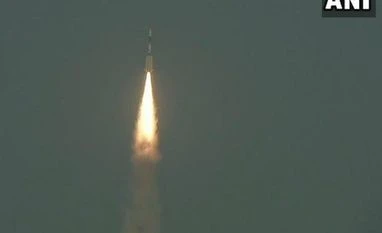
The failure of a GSLV rocket to inject the EOS-03 satellite into the orbit on Thursday comes two years after the ISRO experienced another major setback during the launch of Chandrayaan-2
Press Trust of India New Delhi The failure of a GSLV rocket to inject the EOS-03 satellite into the orbit on Thursday comes two years after the ISRO experienced another major setback during the launch of Chandrayaan-2.
The ambitious Chandrayaan-2 project of the Indian Space Research Organisation (ISRO), aimed at landing a lander on the moon, also did not yield the desired results.
Planned to land on the south pole of the moon, Chandrayaan-2 was launched on July 22, 2019. However, the lander, Vikram, hard-landed on September 7, crushing India's dream to become the first country to successfully land on the lunar surface in its maiden attempt.
With regards to EOS-03, the failure to ignite the cryogenic stage of the launch vehicle prompted the premier space agency to declare that the mission could not be achieved as intended.
According to the ISRO, the cryogenic upper-stage ignition was scheduled to take place 4.56 minutes after the lift-off.
A formal announcement was also made at the Mission Control Centre by the range operations director, stating, "Performance anomaly observed in the cryogenic stage. The mission could not be accomplished fully."
Describing the development as "very unfortunate", former ISRO chairman Madhavan Nair said, "The chances of failure in the cryogenic stage are higher."
A similar failure occurred in 2010 during a launch, but corrective measures were taken and the ISRO had more than six GSLV launches after that.
Nair said there appears to be no major issue, adding, "The ISRO will come back as quickly as possible."
After the GSLV's failure to inject the satellite into the orbit, Union minister Jitendra Singh, in-charge of the Department of Space, said the mission can be rescheduled again.
Ajay Lele, senior fellow at the Manohar Parrikar Institute of Defence Studies, said if there is an issue, it usually comes to light during the countdown of the mission.
"If it has not come to anyone's notice, then it does not appear to be any major issue. It must be some freak problem," he said.
Lele pointed out to the Chandrayaan-2 mission, which had to be postponed due to a technical glitch, and it was detected just before the launch.
Thursday's unsuccessful attempt to launch the satellite came in the wake of scientists postponing the planned missions earlier.
The satellite, originally titled GISAT-1 and weighing 2,268 kg, was slated to be launched on March 5, 2020 but it was postponed a day before the lift-off due to "technical reasons".
The lockdown imposed to curb the spread of COVID-19 further delayed the mission and once again it was scheduled for a March 28, 2021 launch but a "minor issue" with the satellite forced yet another postponement.
The objective of Thursday's mission was to provide near-real-time imaging of large-area regions at frequent intervals for quick monitoring of natural disasters, episodic events and obtain spectral signatures for agriculture, forestry, water bodies as well as for disaster warning, cyclone monitoring, cloud burst and thunderstorm monitoring.
(Only the headline and picture of this report may have been reworked by the Business Standard staff; the rest of the content is auto-generated from a syndicated feed.)

 "Before EOS-03 setback, Chandrayaan-2 too did not yield desired results")


 Connect with us on WhatsApp