Farm debt waivers not favoured by ex-RBI heads

D Subbarao said bank accounts don't translate to financial inclusion; Bimal Jalan said financial inclusion had to be combined with financial stability
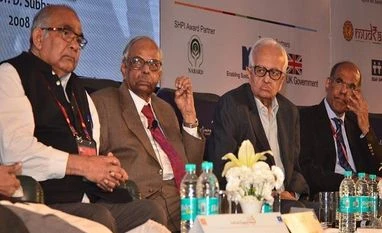
Former RBI Governors (L-R) Y V Reddy, C Rangarajan, Bimal Jalan and D Subbarao at Inclusive Finance India Summit 2017. Photo: Sanjay Sharma
Former RBI Governors (L-R) Y.V.Reddy,C.Rangarajan,Bimal Jalan and D.Subbarao at Inclusive Finance India Summit 2017 in new delhi/sanjay.k.sharma
Somesh Jha New Delhi
Last Updated : Dec 12 2017 | 1:56 AM IST
At a discussion on policy, two former Reserve Bank of India (RBI) governors were critical of the farm debt waiver announcements by some state governments.

Y V Reddy, ex-governor, said such decisions would not help the economy. C Rangarajan, another ex-governor, agreed and said it was better to instead give farmers more time to repay.

"Loan waiver is not good for economic or credit culture. Every political party in India has given farm loan waivers in some state or the other or at all-India level. It is a political decision but cannot be justified in the longer run," Reddy said, on the sidelines of the Inclusive Finance India Summit.

Recent announcements in this regard have been made by the governments of Telangana, Uttar Pradesh, Punjab, Karnataka and Maharashtra.

"First, waive interest payments during a year of distress. Second, reschedule the loan, so that farmers get a longer timeframe for repayment. Only if all these things don't succeed should the government think of loan waiver," said Rangarajan.

During a panel discussion of former RBI governors on financial inclusion, D Subbarao emphasised that providing of bank accounts does not translate to financial inclusion. He gave the example of Ernakulum district in Kerala, where people still borrow from moneylenders despite achieving 100 per cent financial inclusion a few years earlier.

"We do not understand poverty very well. We think poor people want bank accounts because they do not have any avenue for saving money," Subbarao said. "(But) poor people also want bank accounts because they want credit. Poor people will come to the banking system for financial inclusion only if we provide them all that they want -- saving, remittance, credit and insurance."

Former RBI governor Bimal Jalan said financial inclusion had to be combined with financial stability.

The former governors wanted a diversified model for financial inclusion, instead of a common policy. Rangarajan said there has to be a clear distinction between financial inclusion towards credit and financial inclusion towards deposits. "Achieving the former is far more difficult than the latter," he said.

He added that the consolidation of rural banks was a disturbing trend, as "the local character of banks is getting diluted".

One subscription. Two world-class reads.

Already subscribed? Log in

Subscribe to read the full story →
*Subscribe to Business Standard digital and get complimentary access to The New York Times

Smart Quarterly

₹900

3 Months

₹300/Month

SAVE 25%

Smart Essential

₹2,700

1 Year

₹225/Month

SAVE 46%
*Complimentary New York Times access for the 2nd year will be given after 12 months

Super Saver

₹3,900

2 Years

₹162/Month

Subscribe

Renews automatically, cancel anytime

Here’s what’s included in our digital subscription plans

Exclusive premium stories online

  • Over 30 premium stories daily, handpicked by our editors

Complimentary Access to The New York Times

  • News, Games, Cooking, Audio, Wirecutter & The Athletic

Business Standard Epaper

  • Digital replica of our daily newspaper — with options to read, save, and share

Curated Newsletters

  • Insights on markets, finance, politics, tech, and more delivered to your inbox

Market Analysis & Investment Insights

  • In-depth market analysis & insights with access to The Smart Investor

Archives

  • Repository of articles and publications dating back to 1997

Ad-free Reading

  • Uninterrupted reading experience with no advertisements

Seamless Access Across All Devices

  • Access Business Standard across devices — mobile, tablet, or PC, via web or app

Next Story


