GST a nightmare on Day 1: Shops clueless, small businesses scramble

Shops, pharmacies in Mumbai, New Delhi scramble to fight confusion and issue invoices in new regime
GST
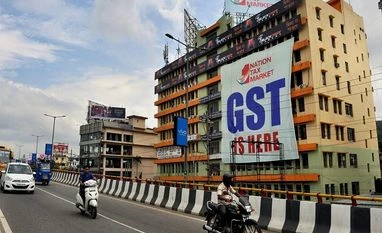
Vehicles move past a huge GST poster on the wall of a building, in Guwahati on Friday. Photo: PTI
Arnab DuttaShubham ParasharAneesh PhadnisVeena Mani New Delhi/Mumbai
Last Updated : Jul 02 2017 | 2:18 PM IST
The goods and services tax (GST) proved to be a nightmare for small traders and businessmen on its first day. Shops and pharmacies in Mumbai, New Delhi and other cities scrambled to issue invoices under the new system.

Organised sector players such as Big Bazaar and DMart were ready to issue GST invoices from Friday midnight, the hour at which the new indirect tax was rolled out. But not everyone was. At the outlet of electronics retailer Croma at Prabhadevi in central Mumbai, customers were still being charged value-added tax (VAT) on Saturday afternoon. Officials said the store would switch to the GST-based billing by the evening, when customer footfall increases.

The situation was not too different in local supermarts and shops in Santa Cruz and Bandra.

Ram Dhir, an owner of a supermarket in Santa Cruz (East), said it would take at least four to five days for the GST software to be uploaded on his billing terminal. “We are in touch with our local trade body and they are helping us out with this. Till then, consumers can continue to buy products at MRP (maximum retail price) plus VAT,” he said.

In the crowded Dadar area of Mumbai, shops across the board, from stationary to sarees, cosmetics to paints, said they were yet to switch to the new tax regime. “The picture is still hazy and we are unclear how do we get going with this (GST),” said Vinit R, a paints dealer in Dadar. His shop was also running low on stocks, as supplies had fallen.

The picture was similar in south Delhi’s Lajpat Nagar central market and the electronics hub at Nehru Place. Both wore a deserted look on Saturday, which is rather unusual. Traders and retailers were unhappy. Worse, a fifth of the shops had downed shutters. Some had limited inventory and the rest were grappling with price tags.

“This is our tryst with destiny,” said Rakesh Bisht, an electronics retailer at Nehru Place. Faiz Ahmed, a footwear shop owner at Lajpat Nagar, said, “While we are almost ready and charging consumers the additional tax burden due to the GST — from about 10 per cent earlier to 18 per cent now — placing orders has become a headache. Manufacturers have told us that no new orders can be processed before 4 July. So we are sending customers away.”

Some others were clueless about it.

A garment trader at Lajpat Nagar, Raju Gupta, continued charging the same price as he did before the GST roll-out. So did Nilesh Pathak, the owner of a curtains shop in the same area. He said, “I do not understand how the GST is going to help small businesses like us. It seems that this will stoke inflation.”

Many, however, were taking action to make the best of the situation.

Pharmaceutical distributors were working overtime through the weekend to update their systems. They will begin invoicing and selling stocks to retail partners from Monday.

In the run-up to the GST roll-out, stockists cut down inventory and industrywide domestic sales in June dropped by 50 per cent, according to some estimates. Sales were expected to pick up over the next few days.

“Stockists will begin selling to retail partners from Monday. We expect companies to take orders and begin supplies in next 2-3 days,” said Jagannath Shinde, president of All India Organisation of Chemists and Druggists.

Abbott and Cipla had already switched over to the new system.

According to S V Veeramani, former president of Indian Drug Manufacturers Association, around 80 per cent of stockists in India were already a part the GST Network.

National Pharmaceutical Pricing Authority (NPPA) Chairman Bhupendra Singh met distributors in Bengaluru on Saturday to get feedback on GST implementation. According to the NPPA, prices of approximately 78 per cent of all actively used and traded drugs in the country will remain unaffected.

One subscription. Two world-class reads.

Already subscribed? Log in

Subscribe to read the full story →
*Subscribe to Business Standard digital and get complimentary access to The New York Times

Smart Quarterly

₹900

3 Months

₹300/Month

SAVE 25%

Smart Essential

₹2,700

1 Year

₹225/Month

SAVE 46%
*Complimentary New York Times access for the 2nd year will be given after 12 months

Super Saver

₹3,900

2 Years

₹162/Month

Subscribe

Renews automatically, cancel anytime

Here’s what’s included in our digital subscription plans

Exclusive premium stories online

  • Over 30 premium stories daily, handpicked by our editors

Complimentary Access to The New York Times

  • News, Games, Cooking, Audio, Wirecutter & The Athletic

Business Standard Epaper

  • Digital replica of our daily newspaper — with options to read, save, and share

Curated Newsletters

  • Insights on markets, finance, politics, tech, and more delivered to your inbox

Market Analysis & Investment Insights

  • In-depth market analysis & insights with access to The Smart Investor

Archives

  • Repository of articles and publications dating back to 1997

Ad-free Reading

  • Uninterrupted reading experience with no advertisements

Seamless Access Across All Devices

  • Access Business Standard across devices — mobile, tablet, or PC, via web or app

Next Story



